About Cassia Tora Splits

Cassia tora splits is manufactured from the seeds of Senna obtusifolia or Cassia obtusifolia or Cassia Tora or Cassia Occidentalis.

Cassia grows mainly in subtropical regions and is grows mostly wild and occasionally cultivated. The name is derived from Latin words “obtus” meaning blunt and “folium” meaning leaf. This is annual plant that mainly grows after the Indian monsoon season. This plant bears pods of nearly 20cm which contain many cylindrical seeds. These are the cassia tora seeds that are usually broken into two halves and referred to as cassia splits.

These splits are usually called by different names like cassia tora gum splits, cassia gum splits, cassia splits, senna splits, cassia senna splits etc.

Specification of Cassia Senna Splits

Odour Typical
Moisture 7% Max.
Ash % 1% Max.
Protein 7% Max.
Black & Red 1% Max.
Dehusking 93%

Manufacturing Process Cassia Tora Splits

The seed consists of an outer husk, an endosperm (cassia tora split), and the ovary or germ. Only the endosperm or split, which contains mainly polysaccharides, is used for the production of cassia gum.

As one of the major cassia split manufacturers, before splitting, the seeds are passed through grading machines to differentiate them on the basis of their size. During this procedure, the underdeveloped seeds are removed and C.occidentalis seeds are reduced to no more than 0.05%.

Both husk and germ are removed in the de-husking and splitting process. The impact of the splitting procedure is that both husk and germ are loosened from the endosperm and made brittle by heating and can be removed in the subsequent purification procedure after pulverization. The split (endosperm), however, remains intact at these temperatures. Due to its much greater particle size, the split can be separated from husk and germ particles through a couple of physical cleaning steps.

The splitting procedure starts with the roasting of the seeds. All seeds are heated for several minutes. During the roasting process the endosperm (split) remains intact and flexible, while husk and germ, which are more sensitive to heat, become brittle. Mechanical stress pulverizes husk and germ and the powder is separated from the intact split by sieving. The remaining traces of husk and germ on the split cassia particles are finally removed through a series of physical cleaning steps.

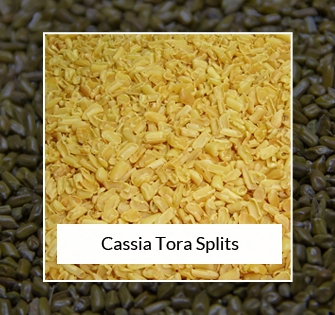
Cassia splits mainly consist of mannose and galactose units. These are pale yellow splits that are normally soluble in hot water. They act as thickening agents and form gels with carrageenan and xanthan. These Cassia Tora splits are often used as food additives. They are used in cattle feed products like dog foods, cat foods, and cow foods.

Cassia Tora Splits Packaging

  • 50 kg net strong HDPE bags with inside liner
  • 800 kg to 1000 kg jumbo bags or big bags

Application of Cassia Splits

  • Making cassia gum powder.
  • Making Textile-grade cassia gum powder
  • Making different cassia derivatives.

Applications of Cassia Tora Splits


Frozen Foods


Foods


Dairy Products


Ketchup, Pickles
and Soups


Pet Food


Poultry

Cassia Tora Splits FAQs

Cassia Tora Splits are pale yellow in color. They are normally soluble in hot water, which is a key processing characteristic for manufacturers using them as a raw material for Cassia Gum Powder and other derivatives. This hot water solubility also makes them effective as thickening agents in food, dairy, frozen food, and pet food applications.

The standard B2B specifications for Cassia Tora Splits are: Odour – Typical; Moisture – 7% Max.; Ash – 1% Max.; Protein – 7% Max.; Black & Red – 1% Max.; Dehusking – 93% minimum. These parameters ensure product consistency for large-volume food, pet food, and industrial buyers.

Cassia Tora Splits are used across multiple B2B industries: they serve as raw material for Cassia Gum Powder and Textile-grade Cassia Gum Powder, and their derived gum is used in Frozen Foods, Dairy Products, Ketchup, Pickles, Soups, Pet Food (dog, cat, and cow food), and Poultry feed formulations.

Cassia Tora Splits are mainly composed of mannose and galactose polysaccharide units. They are soluble in hot water and act as thickening agents. Importantly, they form synergistic gels when combined with carrageenan and xanthan gum, making them highly functional ingredients in food and pet food processing.

Cassia Tora Splits are available in two bulk packaging formats: 50 kg net strong HDPE bags with an inside liner, and 800 kg to 1000 kg jumbo bags (big bags). The jumbo bags are ideal for FCL shipments, while 50 kg bags suit buyers requiring manageable handling units within bulk consignments.

Cassia Tora grows mainly in subtropical regions and is primarily a wild-growing annual plant that thrives after the Indian monsoon season. Cassia Tora Splits are manufactured and exported from India. Avlast Hydrocolloids, located in GIDC Estate, Vatva, Ahmedabad, Gujarat, is one of the established manufacturers and global exporters of Cassia Tora Splits.

Typical international B2B buyers include Cassia Gum Powder manufacturers, pet food producers, frozen and processed food companies, dairy processors, textile manufacturers, poultry feed formulators, and hydrocolloid traders. Buyers from Germany, Japan, France, Netherlands, Australia, South Korea, UK, USA, Brazil, Canada, Singapore, Malaysia, South Africa, and other countries regularly import Cassia Tora Splits from India.

Cassia Tora Splits are the direct precursor to Cassia Gum Powder. The endosperm splits are further milled and purified to produce the finished Cassia Gum Powder. This makes Cassia Splits a critical upstream raw material for any business manufacturing Cassia-based hydrocolloids.

Quality is controlled at multiple stages: seeds are passed through grading machines to remove underdeveloped seeds and reduce Cassia Occidentalis seeds to no more than 0.05%. After roasting, mechanical pulverization separates brittle husk and germ from the intact endosperm. A series of physical cleaning steps then removes remaining traces of husk and germ, ensuring a dehusking level of 93% or above.

In international B2B markets, Cassia Tora Splits are also known as: Cassia Tora Gum Splits, Cassia Gum Splits, Cassia Splits, Senna Splits, and Cassia Senna Splits. Buyers should be aware of these alternate terms when sourcing from different markets.

Each jumbo bag (big bag) of Cassia Tora Splits holds between 800 kg and 1000 kg of product. This makes jumbo bags the preferred packaging choice for large-volume importers and manufacturers seeking to optimize freight and handling costs on full container load (FCL) shipments.

Avlast Hydrocolloids exports bulk Cassia Tora Splits to a wide network of countries including Germany, Japan, France, Netherlands, Australia, Mexico, South Korea, Saudi Arabia, United Kingdom, Philippines, Kenya, Thailand, Ghana, Taiwan, Peru, Hungary, Zambia, Singapore, Sri Lanka, Nepal, Zimbabwe, Poland, Guatemala, Brazil, Malaysia, Myanmar, South Africa, Democratic Republic of the Congo, Colombia, Indonesia, Canada, Bangladesh, Brunei, Spain, Slovenia, Turkiye, Italy, and the United States, among others.

Yes, Avlast Hydrocolloids supports private label and custom manufacturing for international B2B clients. Buyers can specify packaging format, product grade, labelling, and quality parameters to align with their brand requirements and destination market regulations. Interested buyers can reach out at info@avlasthydrocolloids.com to discuss private label arrangements.

Avlast Hydrocolloids holds multiple industry certifications relevant to food-grade and industrial-grade Cassia Tora Splits. Details of all applicable certificates are available on their official certificates page. These certifications are essential references for B2B buyers conducting supplier qualification and regulatory compliance checks.

The Cassia Tora seed consists of three distinct parts: the outer husk, the endosperm (which becomes the Cassia Split), and the ovary or germ. Of these three, only the endosperm contains the polysaccharides required for Cassia Gum production. The husk and germ are removed during processing — the husk and germ become brittle through roasting and are pulverized and separated, while the endosperm remains intact and is retained as the Cassia Split.