
Guar Gum Powder in Paper and Pulp Manufacturing: Strength and Sizing Applications
AI Summary
Guar gum powder is used in paper and pulp manufacturing as a dry strength additive and surface sizing agent, improving fiber bonding, reducing fiber loss during production and enhancing surface smoothness in finished paper. It offers a natural, cost effective alternative to some synthetic additives, with certified supply available from processors such as Avlast Hydrocolloids for paper mills evaluating natural strength additives.
Paper manufacturing depends heavily on how well individual fibers bond together during the pulping and sheet forming process. Guar gum powder plays a supporting but meaningful role in this process, used by paper mills around the world to improve both production efficiency and finished sheet quality.
The Role of Guar Gum Powder in Paper Manufacturing
During paper production, pulp fibers are suspended in water and formed into sheets on a moving wire. Additives are introduced at various stages to improve how well these fibers bond, how much fiber is retained on the wire, and how the finished sheet performs during printing or further processing.
Guar gum powder is added primarily for its ability to improve fiber to fiber bonding and reduce the loss of fine fiber particles during the sheet forming process, both of which directly affect paper strength and production efficiency.
Guar Gum Powder as a Dry Strength Additive
Dry strength additives improve the bonding between cellulose fibers once the paper sheet has dried, resulting in a stronger finished product that resists tearing and handles better during printing, converting and packaging processes.
Guar gum powder functions as a natural dry strength additive by forming hydrogen bonds with cellulose fibers, similar in principle to how it interacts with water molecules during hydration. This improves fiber bonding without requiring synthetic polymer additives.
Guar Gum Powder in Surface Sizing Applications
Surface sizing involves applying a thin coating to the paper surface after initial sheet formation, improving smoothness, controlling ink absorption and enhancing the overall printability of the finished paper. Guar gum powder is used in some surface sizing formulations for its film forming and viscosity control properties.
Paper grades intended for high quality printing, such as coated papers used in packaging and commercial printing, often benefit from the smoother surface finish that a well formulated sizing solution containing guar gum powder can help achieve.
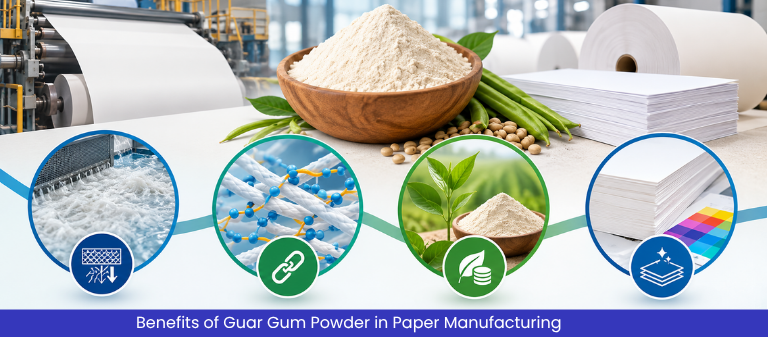
Benefits of Using Guar Gum Powder in Paper and Pulp Manufacturing
- Improved fiber retention: guar gum powder helps reduce fine fiber loss during the sheet forming process, improving production yield.
- Enhanced dry strength: hydrogen bonding between guar gum powder and cellulose fibers improves finished sheet strength.
- Natural, cost effective option: guar gum powder offers a plant based alternative to certain synthetic strength additives.
- Improved surface smoothness: supports better printability in sizing applications for coated and commercial printing paper grades.
- Compatibility with existing paper mill processes: guar gum powder can typically be integrated into standard wet end and surface sizing systems without major equipment changes.
Comparing Guar Gum Powder and Starch in Paper Manufacturing
| Characteristic | Guar Gum Powder | Starch Based Additives |
| Source | Guar seed endosperm | Corn, potato or other starch sources |
| Fiber bonding mechanism | Hydrogen bonding with cellulose fibers | Hydrogen bonding, generally lower efficiency at equal dosage |
| Typical dosage required | Lower dosage often achieves comparable strength gains | Often requires higher dosage for similar performance |
| Common application | Dry strength and surface sizing | Widely used in surface sizing and coating formulations |
Sourcing Guar Gum Powder for Paper Mill Applications
Paper mills typically require technical grade guar gum powder with consistent viscosity and controlled mesh size, since dosing accuracy affects both cost efficiency and finished paper quality. Mills operating continuous production lines particularly value predictable hydration behavior to avoid process disruptions.
Working with an established guar gum manufacturer that can supply consistent bulk quantities with documented technical specifications helps paper mills maintain stable production quality across ongoing operations.
Guar Gum Powder in Specialty and Packaging Grade Paper
Beyond standard printing and writing paper, guar gum powder is also used in the production of specialty paper grades, including certain packaging papers where fiber strength and controlled surface porosity are particularly important for the finished product’s performance.
Packaging paper manufacturers producing food contact or corrugated packaging materials sometimes favor guar gum powder specifically for its natural origin, which can support broader clean label or sustainability claims made further down the packaging supply chain by brand owners using the finished packaging material.
Dosage Considerations and Mill Trial Best Practices
Guar gum powder dosage in paper manufacturing varies depending on pulp furnish, target strength properties and the specific point of addition within the production process. Mills typically begin with a conservative dosage during initial trials, then adjust gradually while monitoring strength testing results and production line behavior.
Running a controlled mill trial, ideally comparing a guar gum powder treated batch against a standard production batch under otherwise identical conditions, gives mills the clearest picture of actual performance gains before committing to a permanent dosage change across full scale production.
Paper mills switching from an existing additive system to guar gum powder often find it useful to work closely with their supplier’s technical team during this trial phase, since dosage and addition point can significantly affect the strength and retention benefits ultimately achieved.
 Call Now
About Avlast Hydrocolloids
Avlast Hydrocolloids is a manufacturer, processor and exporter of guar gum powder, guar splits and guar meal, based in Ahmedabad, India, active in the hydrocolloids industry since 2006 and currently supplying customers across more than 30 countries, including industrial buyers in the paper and pulp manufacturing sector.
The company supplies technical grade guar gum powder suited to paper mill applications, with documentation covering viscosity, mesh size and batch consistency to support both dry strength and surface sizing formulations.
Avlast Hydrocolloids can provide sample quantities for mill trials, allowing paper manufacturers to evaluate performance under their specific production conditions before committing to a bulk supply arrangement.
Conclusion
Guar gum powder offers paper and pulp manufacturers a natural, effective option for improving fiber bonding, retention and surface quality across both dry strength and surface sizing applications. As paper mills continue to look for cost effective, sustainable additive options, guar gum powder remains a well established choice worth evaluating alongside traditional starch based systems.
Frequently Asked Questions
What does guar gum powder do in paper manufacturing?
Guar gum powder improves fiber to fiber bonding and reduces fine fiber loss during the sheet forming process, functioning as both a dry strength additive and, in some formulations, a surface sizing agent that improves finished paper smoothness.
How does guar gum powder improve paper strength?
Guar gum powder forms hydrogen bonds with cellulose fibers, similar to how it interacts with water during hydration, which improves fiber bonding and results in a stronger finished paper sheet that resists tearing during handling and processing.
Is guar gum powder used in all types of paper manufacturing?
Guar gum powder is commonly used across various paper grades, with particular relevance to coated and commercial printing papers where surface smoothness and printability are important quality factors, though its use varies by mill and specific formulation requirements.
How does guar gum powder compare to starch based additives in paper mills?
Guar gum powder often achieves comparable strength improvements at a lower dosage than starch based additives, though both are natural options used across dry strength and surface sizing applications, with the choice often depending on cost, availability and specific mill requirements.
What grade of guar gum powder is used in paper manufacturing?
Paper mills typically use technical grade guar gum powder with consistent viscosity and controlled mesh size, since dosing accuracy directly affects both cost efficiency and finished paper quality in continuous production processes.
Can guar gum powder be added to existing paper mill processes without equipment changes?
In most cases, yes. Guar gum powder can typically be integrated into standard wet end and surface sizing systems already used in paper mills, without requiring significant equipment modifications, though dosing should be confirmed through mill trials.
Does guar gum powder help with fiber retention during paper production?
Yes, guar gum powder helps reduce the loss of fine fiber particles during the sheet forming process, which improves overall production yield and reduces the amount of fiber lost to process water during manufacturing.
How should a paper mill determine the right guar gum powder dosage?
Mills typically start with a conservative dosage during a controlled trial, comparing a treated batch against a standard production batch under otherwise identical conditions, then adjust gradually based on strength testing results and production line behavior before finalizing a permanent dosage.
Is guar gum powder suitable for packaging grade paper production?
Yes, guar gum powder is used in certain specialty and packaging grade papers where fiber strength and controlled surface porosity matter, and its natural origin can also support clean label or sustainability claims made further down the packaging supply chain.
Should a paper mill work with its guar gum powder supplier during the initial trial phase?
Yes, working closely with the supplier's technical team during trial runs is generally recommended, since dosage and addition point can significantly affect the strength and retention benefits achieved, and supplier input can help avoid unnecessary trial and error on the mill's own production line.