
Cassia Gum Powder Export to South Korea: Food, Pet Food and Personal Care Manufacturing Demand
AI Summary
- South Korea has a pet food market worth well over one billion US dollars, with a growing wet pet food segment.
- Domestic manufacturers are scaling up and need dependable suppliers of gelling agents such as cassia gum powder.
- The government plans to align pet food standards with US and EU rules, so European style naming and purity documents are likely to be familiar to buyers.
- Korean buyers expect detailed technical data, including hot water hydration instructions, since cassia gum powder is soluble only in hot water.
- Avlast Hydrocolloids exports cassia gum powder in bulk to more than 30 countries.
South Korea has its own long tradition of cassia tora seed, so this guide concerns processed cassia gum powder rather than whole seed. The opportunity for exporters lies in the refined gum used by manufacturers.
The sections below explain where demand is growing, what Korean buyers expect from a supplier and how to prepare for regulatory questions.
Why South Korea Is Worth Targeting for Cassia Gum Powder
South Korea combines a modern manufacturing base with a population that spends heavily on pets and personal care. Both trends increase demand for functional ingredients that improve texture and stability.
Market researchers project the Korean pet food market to keep growing through the early 2030s, helped by rising pet ownership and interest in premium products. This gives suppliers of gelling agents a steady long term market.
South Korea Wet Pet Food Segment and Humanisation: Demand for Cassia Gum Powder
Research firm Bonafide Research valued the Korean wet pet food market at more than 260 million US dollars in 2024, driven by pet adoption and a shift toward higher protein, premium products.
Humanisation is a central theme. Korean owners increasingly treat pets as family and look for natural ingredients and clear labels, which pushes manufacturers toward carefully chosen additives and well documented suppliers.
Euromonitor also notes that cat food is capturing the fastest growth in Korean pet care, which supports interest in convenient formats such as pouches and trays.
Korean Pet Food Manufacturing and Cassia Gum Powder Ingredient Sourcing
A report from the United States Department of Agriculture notes that imports of finished pet food in Korea declined in 2023 for the first time in more than a decade, with local competition a likely cause.
The government has also set a target to raise Korean pet food exports from about 149 million US dollars in 2022 to 500 million US dollars by 2027.
As domestic manufacturers expand to meet both local demand and export goals, they need dependable ingredient suppliers. Gelling agents such as cassia gum powder are part of that supply chain.
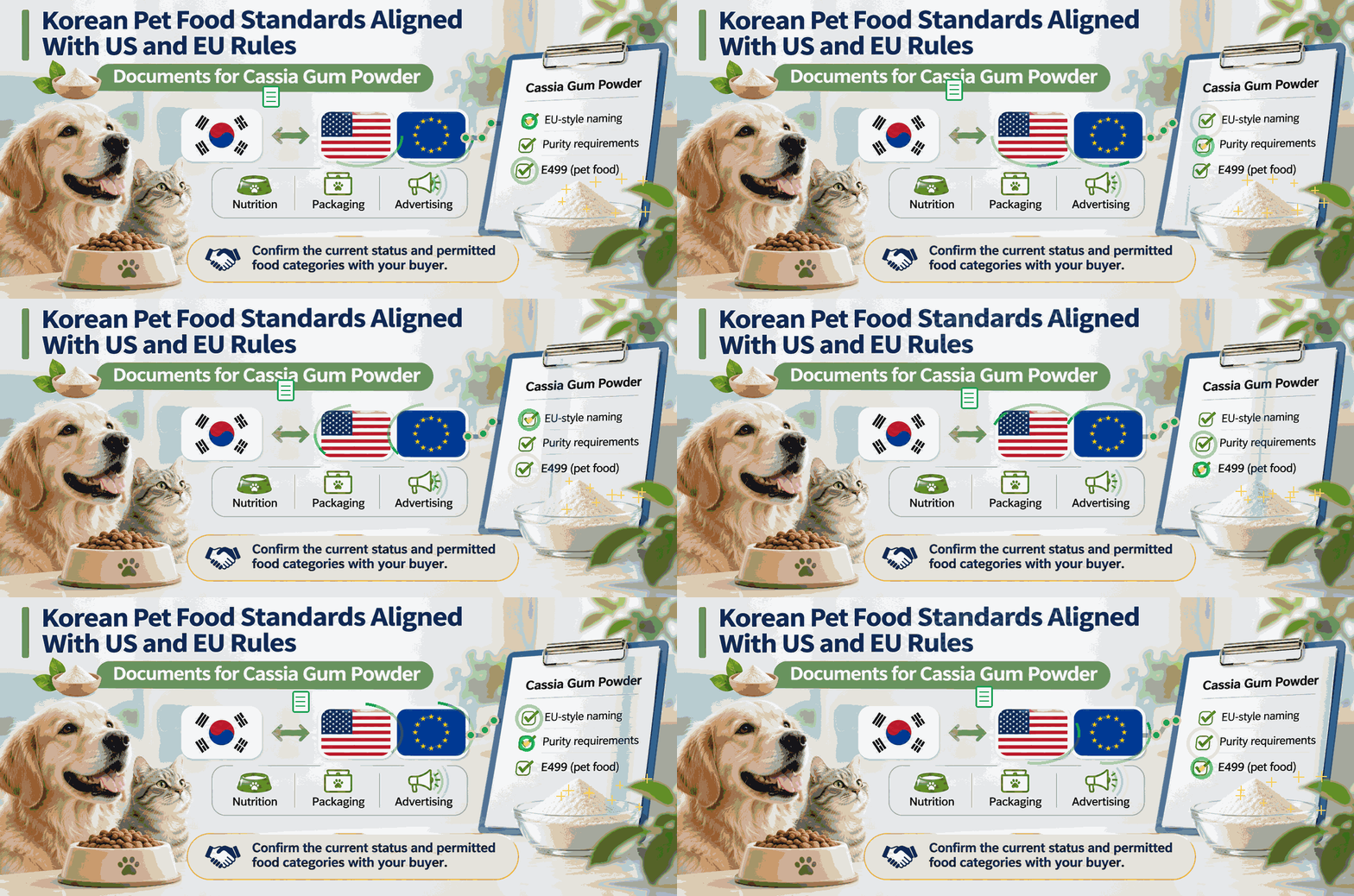
Korean Pet Food Standards Aligned With US and EU Rules: Documents for Cassia Gum Powder
Korea’s agriculture ministry has announced plans to align pet food standards for nutrition, packaging and advertising with those of the United States and the European Union.
For cassia gum powder suppliers, this alignment is helpful. Documents built around European style naming and purity requirements, including the E499 designation for pet food, are likely to be familiar to Korean quality teams.
Exporters should still confirm the current status of cassia gum for pet food and for each food category directly with the buyer, since local rules govern what is permitted.
Cassia Gum Powder in Korean Food Manufacturing
Cassia gum has an established regulatory history in East Asia. Japan added it to its list of approved food additives in 1995, which shows that the gum is accepted in the region.
Korean food manufacturers produce desserts, beverages and processed foods, all areas where thickeners and gelling agents are used. Importers should check the permitted categories and limits for cassia gum in Korea before planning an application.
Formulators need to account for the fact that cassia gum powder is soluble only in hot water. Recipes should include a heating step so that the gum fully hydrates and develops its structure.
Personal Care and Cosmetic Uses of Cassia Gum Derivatives
Chemically modified cassia derivatives have been developed for conditioning and thickening in hair care formulations. This shows that cassia based polymers have uses beyond food and pet food.
South Korea’s personal care industry is known internationally for innovation. Because manufacturers in this sector keep a close watch on new ingredients, buyers may enquire about cassia products.
Exporters should be open about what they supply. Avlast Hydrocolloids supplies cassia gum powder as a hydrocolloid, and buyers needing specially modified grades should discuss their requirements directly.
Technical Documentation Korean Buyers Expect From a Cassia Gum Powder Supplier
Buyers in regulated manufacturing markets such as Korea commonly ask for detailed technical data. A complete package includes a certificate of analysis for each batch, a viscosity profile, particle size information and clear hydration instructions.
Hydration instructions should state that cassia gum powder is soluble only in hot water and give the recommended temperature and time. This detail lets process engineers plan their lines correctly.
Korean buyers often work through local importers who translate technical documents. Clear English documents with consistent terminology make that translation faster and reduce the chance of errors.
Shipping Cassia Gum Powder to Busan and Incheon
Busan is the main container port in South Korea, and Incheon serves the Seoul region. Most bulk ingredient shipments arrive at one of these two ports.
Moisture protection is essential on the sea route, so inner liners and sealed outer packaging are standard. Reliable delivery schedules are valued highly, since Korean manufacturers plan production tightly.
Working With Korean Importers and Distributors of Cassia Gum Powder
Many Korean manufacturers buy imported ingredients through trading companies and distributors that know local regulations and customs procedures. These partners are an important link between the exporter and the final user.
Exporters should give them complete, well organised documents and answer questions promptly, since a slow reply can delay the approval of a new supplier.
Clear communication about specifications, packaging and delivery schedules helps distributors represent the product accurately to Korean food, pet food and personal care manufacturers.
Cassia Gum Powder Sample Trials and Long Term Supply Relationships in Korea
Korean manufacturers usually test a new ingredient on a small scale before approving it for production. Supplying a sample lot with a full specification lets their technical teams run trials on their own equipment.
Once a supplier has passed this stage, buyers value stable quality and dependable delivery over many orders. Consistent performance of the cassia gum powder from one batch to the next builds the trust that leads to long term supply agreements.
 Call Now
About Avlast Hydrocolloids: Cassia Gum Powder Exporter to South Korea
Avlast Hydrocolloids is a manufacturer, processor and exporter of cassia gum powder, cassia tora splits, cassia tora meal and guar gum products, based in Ahmedabad, India. The company was founded in 2006 and currently exports to more than 30 countries.
For Korean buyers, Avlast Hydrocolloids provides batch specific certificates of analysis and detailed technical data sheets for cassia gum powder, including hydration guidance. Avlast Hydrocolloids holds Kosher and Halal certificates, and its processing of cassia gum powder for food industries is certified under FSSC 22000.
The company works directly with importers and manufacturers to arrange sample lots and confirm specifications before a bulk order is placed.
Conclusion: Cassia Gum Powder Export to South Korea
South Korea offers growing demand for cassia gum powder across pet food, food processing and personal care. Exporters who provide detailed documentation, reliable delivery and clear regulatory information are best placed to build lasting relationships with Korean manufacturers.
Frequently Asked Questions About Cassia Gum Powder Export to South Korea
Why is Korean pet food demand relevant to cassia gum powder?
Wet pet food needs gelling agents to keep jelly stable and pieces suspended, and cassia gum powder is widely used for this role. Korea's wet pet food segment is growing, driven by humanisation and premium products. That growth creates demand for the ingredients that support wet food texture.
Is cassia gum powder approved in South Korea?
Approval depends on the intended use, whether food or pet food, and on current Korean rules. Japan has approved cassia gum as a food additive since 1995, but exporters should confirm the Korean position directly with their buyer. A clear specification and purity data make that check easier.
Does this guide cover cassia tora seeds?
No. South Korea has its own tradition of cassia tora seed, so this guide focuses on processed cassia gum powder. The gum is a refined hydrocolloid used by manufacturers as a thickener and gelling agent.
Why is hot water hydration important for Korean buyers?
Cassia gum powder is soluble only in hot water and does not fully dissolve in cold water. Process engineers need to know the recommended temperature and time so they can plan heating steps. Including this in the data sheet avoids trial and error on the production line.
What documents do Korean buyers expect from a cassia gum powder supplier?
Buyers typically ask for a batch specific certificate of analysis, a technical data sheet with viscosity and particle size information, and hydration instructions. They may also request a safety data sheet and food safety statements. Detailed, consistent documents help local importers translate and submit them quickly.
How do Korean pet food policies affect ingredient suppliers?
The government plans to align pet food standards with those of the United States and European Union and to raise pet food exports. Domestic manufacturers are therefore scaling up and improving quality systems. This increases their need for suppliers who can provide reliable, well documented ingredients.
Which ports are used for cassia gum powder shipments to South Korea?
Busan is the main container port, and Incheon serves the Seoul region. The best choice depends on the buyer's plant location. Exporters should confirm the destination port and the required documents with the importer.
Dhaval Patel is the CEO of Avlast Hydrocolloids, a manufacturer, supplier and exporter of hydrocolloid products based in Ahmedabad, India. Avlast Hydrocolloids specializes in Guar Gum and Cassia Gum products, serving customers across food, pet food, animal feed, pharmaceutical, personal care and various industrial applications.
With a strong focus on product quality, consistency and application-specific requirements, Avlast Hydrocolloids offers products including Guar Gum Powder, Fast Hydration Guar Gum Powder, Guar Refined Splits, Cassia Gum Powder, Cassia Tora Splits and other hydrocolloid ingredients. The company serves both domestic and international markets, with a focus on meeting industry-specific quality and performance requirements.
Through its industry-focused content, Avlast Hydrocolloids shares practical and informative insights about guar gum, cassia gum, hydrocolloids, their properties, applications, specifications and use across different industries. The content is intended to provide accurate and useful information for manufacturers, formulators, buyers, importers and other professionals looking to understand hydrocolloid ingredients and their applications.