
Medicinal and Health Benefits of Guar Gum: Managing IBS, Obesity, Cholesterol & Diabetes in Remote Areas of South Africa
Across the vast rural stretches of South Africa – from the arid Karoo to the remote villages of Limpopo – communities face persistent health challenges with limited access to specialized medical infrastructure. Conditions such as irritable bowel syndrome (IBS), obesity, elevated cholesterol and type 2 diabetes are no longer exclusive to urban populations. They have quietly become widespread concerns in these underserved regions, where dietary habits, limited healthcare access and economic constraints compound the difficulty of managing chronic illness. In this context, plant-derived functional ingredients are gaining renewed clinical and nutritional interest. Among them, guar gum – derived from the endosperm of the guar plant – is drawing attention not just as an industrial additive but as a medically relevant dietary fiber with documented therapeutic properties.
Guar Gum Benefits for Gut Health: How It Directly Addresses IBS in Rural South African Diets
Irritable bowel syndrome is one of the most poorly managed gastrointestinal conditions in remote South Africa, largely because diagnosis requires specialist consultation that most rural residents cannot readily access. Symptomatic relief often depends on dietary modification – which is precisely where guar gum demonstrates measurable clinical value.
Partially hydrolyzed guar gum (PHGG), in particular, has been studied extensively for its ability to regulate bowel function without triggering the bloating and cramping often associated with other fiber supplements. Unlike insoluble fibers that add bulk mechanically, PHGG functions as a prebiotic – fermenting slowly in the colon, feeding beneficial gut bacteria and modulating transit time in both constipation-predominant and diarrhea-predominant IBS. A number of peer-reviewed studies have confirmed that PHGG significantly reduces IBS symptom scores, particularly in populations consuming low-fiber diets – a dietary pattern that mirrors much of the rural South African context, where processed maize meal and refined carbohydrates dominate daily intake.
The fact that guar gum can be incorporated into existing foods as a virtually tasteless, odorless powder makes it a practical intervention. For communities where healthcare infrastructure is sparse, the ability to address gut dysfunction through a food-grade ingredient rather than pharmaceuticals is not merely convenient – it is genuinely consequential.
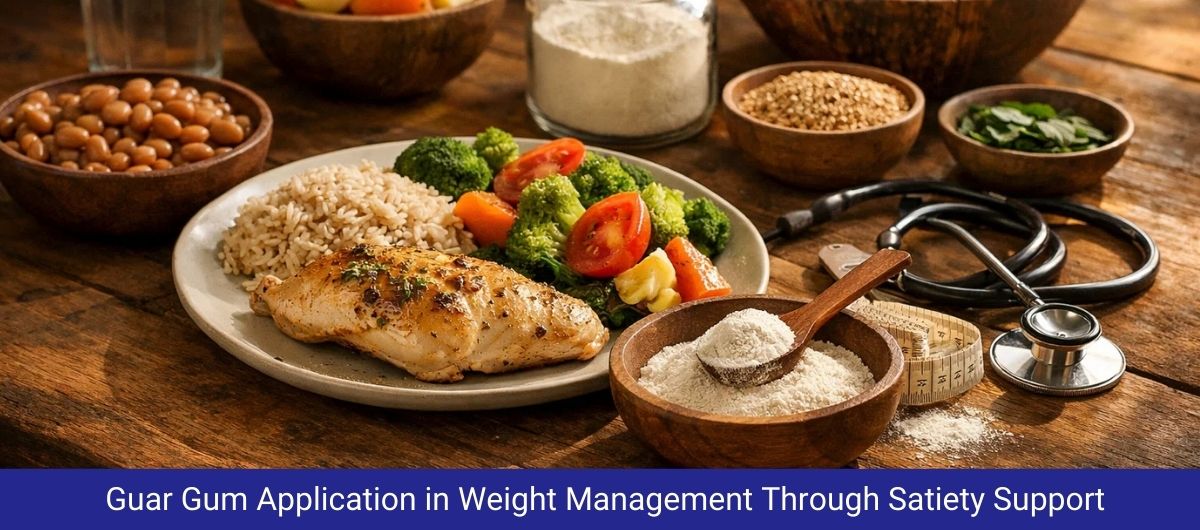
Guar Gum Application in Weight Management: Addressing Obesity through Satiety Mechanisms
Rural obesity in South Africa presents a paradox – it coexists with food insecurity, driven not by caloric excess but by poor dietary quality. Highly refined, low-nutrient foods that spike blood sugar and fail to produce lasting satiety are at the core of this problem. The use of guar gum as a viscous soluble fiber directly counters this dynamic through its well-documented satiety-enhancing mechanism.
When ingested, guar gum forms a gel-like matrix in the gastrointestinal tract. This slows gastric emptying, extends the feeling of fullness and reduces the frequency of eating episodes. Clinical trials have shown that incorporating guar gum into meals can reduce voluntary caloric intake without altering the macronutrient composition of the diet – a meaningful distinction for populations where dietary variety is already limited.
For rural South Africans who cannot access bariatric programs, pharmacological appetite suppressants or structured clinical nutrition plans, the guar gum application as a food-based appetite regulator represents a practical, low-cost and evidence-supported alternative. Its incorporation into local staples like porridge or stews does not require reformulation skills or expensive equipment – a critical consideration given the realities of low-income household kitchens.
 Call Us Now!
Use of Guar Gum in Managing Cholesterol: Disrupting Lipid Absorption Pathways
Cardiovascular disease linked to dyslipidemia is rising across South Africa’s rural communities, yet cholesterol-lowering interventions remain largely inaccessible to those outside urban healthcare networks. Statins and other pharmaceutical lipid-modifying agents require consistent medical monitoring and come at costs that many rural households cannot absorb. The uses of guar gum offers a dietary route to cholesterol modulation that is both scientifically supported and logistically accessible.
Guar gum’s soluble fiber content interferes with bile acid reabsorption in the small intestine. Bile acids, synthesized from cholesterol in the liver, are normally recycled through enterohepatic circulation. When guar gum binds to these bile acids and facilitates their excretion, the liver compensates by drawing on circulating LDL cholesterol to synthesize new bile acids – effectively reducing serum LDL levels. This mechanism is well-established in nutritional biochemistry and has been confirmed across multiple human trials.
Meta-analyses examining the benefits of guar gum supplementation on lipid profiles consistently show reductions in total cholesterol and LDL cholesterol, with minimal impact on HDL cholesterol. For a rural population consuming diets heavy in saturated fats from animal products – including tallow, offal and full-fat dairy – this lipid-buffering property carries real preventive significance.
Guar Splits and the Source of Medicinal-Grade Quality: Understanding What Drives Therapeutic Efficacy
The therapeutic effectiveness of guar gum is not incidental – it is directly tied to the quality of the raw material from which it is derived. Guar splits, the processed halves of the guar seed after the husk is removed, form the foundational ingredient in guar gum powder production. The quality of the endosperm in these splits – specifically the galactomannan content and molecular weight – determines the viscosity and functional behavior of the resulting gum.
Higher-grade guar splits yield with superior water-binding capacity, more consistent gel formation and more predictable physiological effects in the digestive tract. This matters enormously when guar gum is positioned not just as a food additive but as a functional health ingredient for managing chronic disease. Inferior processing or low-quality raw material can compromise the gum’s ability to achieve the viscosity required for effective lipid binding, glucose attenuation or prebiotic activity.
This is why the sourcing of guar gum for health applications – particularly in markets where it is being used as a therapeutic dietary supplement – requires rigorous attention to upstream quality. The integrity of the guar splits used in production is the first determinant of whether the final product will deliver medically relevant outcomes.
Guar Gum in India: The Production Hub Supplying Africa’s Health-Oriented Markets
India accounts for approximately 80–85% of global guar production, with Rajasthan serving as the heartland of cultivation and processing. The country’s dominance in this sector is the result of decades of agricultural specialization, processing infrastructure development and export market experience. Guar gum in India is produced across a wide quality spectrum – ranging from food-grade and pharmaceutical-grade to industrial guar gum powder used in oil drilling and textile processing.
For health applications reaching markets like South Africa – especially rural regions where the ingredient is intended for dietary supplementation – the relevant grade is food-grade or pharmaceutical-grade guar gum, processed under controlled conditions that preserve the galactomannan integrity and ensure freedom from microbial contamination and heavy metal residues.
The cost structure of guar gum in India, combined with the country’s processing scale, makes the guar gum export price competitive even when quality-grade specifications are applied. For organizations – whether NGOs, government nutrition programs or private food companies – looking to introduce guar gum into South African health initiatives, India remains the most logistically and economically viable source.
Guar Gum Powder Manufacturer Standards: What Health Applications Demand Beyond Industrial Grades
Not all guar gum is equivalent in its health application potential. Industrial guar gum powder – widely used in hydraulic fracturing, paper manufacturing and textile sizing – is processed to viscosity and particle size specifications designed for non-food performance. It undergoes different quality controls and may contain residuals that are acceptable in industrial contexts but inappropriate in dietary applications.
A Guar Gum Powder Manufacturer producing for health, food and pharmaceutical markets operates under substantially different standards. These include compliance with food safety management systems such as HACCP and ISO 22000, testing for pesticide residues, microbiological safety and verification of galactomannan content as a functional quality indicator. The guar gum powder price for food- or pharmaceutical-grade product reflects this elevated processing rigor.
When South African health programs, rural nutrition interventions or functional food manufacturers source guar gum for therapeutic use, the manufacturer’s certification and grade specification are not administrative details – they are clinical prerequisites.
Guar Gum Exporters and Supplier Selection: Ensuring Therapeutic Consistency across Long Supply Chains
The distance between India’s production centers and South Africa’s rural consumption zones is significant – both geographically and logistically. For guar gum to reach remote communities with its functional properties intact, the supply chain must preserve product integrity from warehouse to end use. Humidity, temperature variation and improper packaging can degrade guar gum powder, reducing its viscosity and compromising its health application potential.
Reputable Guar Gum Exporters understand that export-grade packaging, moisture-barrier materials and documented cold-chain or dry-chain handling protocols are non-negotiable for health-grade consignments. A reliable guar gum supplier to health-oriented markets in Africa will provide consistent lot-to-lot quality, complete documentation including certificates of analysis and batch traceability.
For organizations managing diabetes prevention programs, community nutrition interventions or IBS management initiatives in South Africa’s rural provinces, partnering with a vetted Guar Gum Powder Exporter – rather than sourcing through commodity brokers unfamiliar with food-grade compliance – significantly reduces the risk of receiving substandard material that fails to produce the intended therapeutic outcomes.
Guar Powder for Diabetes Management: Attenuating Postprandial Glucose Spikes in High-Starch Diets
Type 2 diabetes is one of the fastest-growing chronic conditions in South Africa, with rural prevalence increasingly matching urban rates. The dietary driver is consistent: heavy consumption of refined starches – white maize meal, white bread and sweetened beverages – creates chronic postprandial hyperglycemia that, over time, exhausts insulin response capacity.
Guar powder, when incorporated into starchy meals, significantly reduces the rate of glucose absorption in the small intestine. The mechanism is viscosity-mediated: guar gum forms a gel that physically impedes the access of amylase enzymes to starch molecules, slowing hydrolysis and subsequent glucose entry into the bloodstream. The result is a flattened postprandial glucose curve – a critical therapeutic target in both diabetes prevention and management.
Clinical studies using guar gum supplementation in diabetic patients have demonstrated reductions in fasting blood glucose, HbA1c levels and postprandial glucose peaks. These outcomes, achieved through dietary modification rather than pharmacological intervention, are particularly relevant in remote South African communities where insulin and oral hypoglycemic agents are inconsistently available and require ongoing medical oversight that many residents cannot reliably access.
The practical application is straightforward: incorporating guar powder into the preparation of maize porridge, a staple meal across rural South Africa, introduces a glycemic-attenuating effect into an otherwise high-glycemic dietary pattern without requiring a fundamental change in food culture or cooking practice.
Conclusion
The convergence of scientific evidence and logistical accessibility makes guar gum one of the more compelling functional ingredients available for addressing chronic disease burden in remote South African communities. Its capacity to modulate gut function, reduce lipid absorption, attenuate glucose spikes and support weight management through satiety – all through a single plant-derived fiber – reflects a breadth of therapeutic utility that few food-grade ingredients can match. As interest in evidence-based nutritional interventions grows across Africa’s public health sector, guar gum’s role is likely to expand well beyond its traditional industrial identity and into the domain of community health nutrition.
