
Read Our Article
Cassia Gum Powder in Eco-Conscious Beauty Products: Natural Solutions for Sensitive SkinCassia Gum Powder: A Key Ingredient for Affordable High-Quality Food in Southeast Asia
AI Summary
Cassia gum powder has emerged as a vital, cost-effective ingredient for Southeast Asia’s rapidly growing food markets, particularly in Indonesia, Vietnam, and Thailand. Derived from Cassia tora seeds, this natural stabilizer provides the essential texture and moisture retention needed for high-volume products like instant noodles, processed meats, and dairy alternatives. Its ability to act as an affordable alternative to more expensive gums allows manufacturers to maintain high-quality standards for an expanding middle class while keeping prices accessible for budget-conscious consumers. Supported by a robust supply chain from India and aligning with international safety standards, cassia gum is now a cornerstone of the region’s drive toward efficient and modern food production.
Cassia Gum Powder: Key Ingredient for High-Quality Food in Southeast Asia
Southeast Asia is one of the world’s fastest-growing food markets. With a combined population of million people and a rapidly expanding middle class, the demand for affordable, high-quality processed foods is growing steadily across countries like Indonesia, Vietnam, Thailand, the Philippines, Malaysia and Myanmar. In this context, food manufacturers are consistently looking for cost-effective, functional ingredients that can help them meet both quality standards and price sensitivity. Among the various food additives gaining traction in the region, cassia gum powder has emerged as a widely adopted solution in food processing applications.
Derived from the endosperm of Senna obtusifolia seeds, this natural polysaccharide functions as a thickener, stabilizer and gelling agent. Its compatibility with other hydrocolloids and its relatively accessible price point compared to alternatives make it an attractive option for food producers across Southeast Asian markets.
We are Fast in Response
Contact Now!
Cassia Tora: Origins and Agricultural Context in South and Southeast Asia
The raw material behind cassia powder originates primarily from cassia tora, a leguminous plant that grows abundantly in tropical and subtropical regions. While India remains the largest producer of cassia tora seeds globally, much of the processed output finds its way into Southeast Asian food industries. Countries like Thailand and Vietnam have become significant transit and processing hubs for this ingredient, leveraging their established food manufacturing infrastructure.
Cassia tora uses extend across multiple sectors, but in Southeast Asia, its role in the food industry is especially prominent. The seeds are processed to extract the endosperm, which is then milled into a fine powder. This powder undergoes heat treatment and purification to meet food-grade standards as per regulatory frameworks.
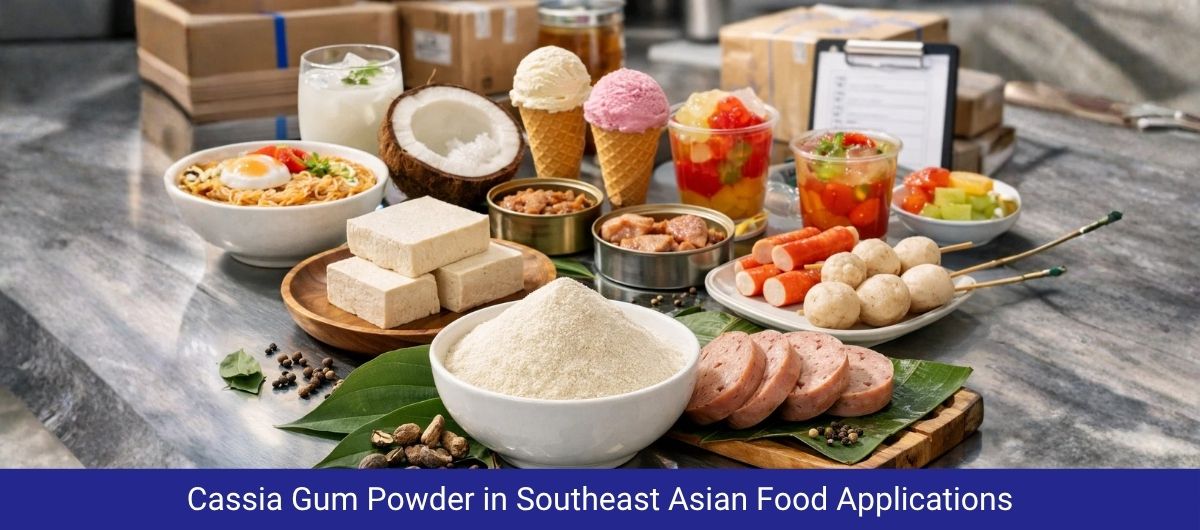
Cassia Gum Powder Uses in Southeast Asian Food Systems
Across Southeast Asia, food manufacturers incorporate cassia gum powder uses into a diverse range of product categories. In Indonesia, which is home to one of the largest instant noodle industries in the world, producers use this ingredient to improve texture consistency and moisture retention in noodle products. The powder also finds application in the country’s thriving dairy analogue sector, particularly in coconut milk-based beverages and tofu-style products that require a controlled gel structure.
In Vietnam, the ingredient is used extensively in processed meat products such as cha lua, a popular pork sausage, where stabilizers help maintain the firm yet elastic texture that consumers expect. Vietnamese food manufacturers also use it in ice cream and frozen dessert production, where it works synergistically with other gums to control ice crystal formation.
Thailand, with its well-developed processed food export industry, employs cassia powder in canned seafood products, fish balls and surimi-based items. The gum’s ability to retain water and form a smooth gel at moderate concentrations makes it suitable for these applications. Additionally, Thailand’s beverage industry uses it in jelly drinks and fruit preparations, a fast-growing sub-category driven by consumer demand for novel textures.
Our Other Product
Guar Gum PowderGomme de Cassia: European Recognition and Its Influence on Asian Export Standards
The term gomme de cassia is used in French-speaking European regulatory contexts, particularly within the European Food Safety Authority (EFSA). The approval of gomme de cassia in the European Union has played an indirect but significant role in shaping how Southeast Asian food manufacturers approach quality and documentation for this ingredient.
For manufacturers in the Philippines and Malaysia who produce food products for export to Europe, meeting the specifications associated with E499 has become a standard requirement. This has encouraged processors in those countries to source from verified cassia gum powder suppliers who can provide batch-specific certificates of analysis, allergen declarations and traceability documentation in line with EU standards.
Cassia Gum Powder Suppliers and the Regional Supply Chain
The supply network for cassia gum across Southeast Asia involves a layered structure of producers, processors and traders. Most of the raw seed supply originates in Indian states like Rajasthan and Gujarat, where wild-harvested and semi-cultivated cassia tora is collected seasonally. Cassia gum powder exporters in India then process the seeds into various grades of food-grade powder and ship to buyers in Southeast Asia.
In Thailand and Malaysia, regional distributors often act as intermediaries who maintain warehouse stock and serve small- to mid-sized food manufacturers that do not procure in large volumes directly. These distributors also provide technical support, formulation guidance and product samples, lowering the barrier for smaller companies to trial the ingredient before committing to larger volumes.
Myanmar and Cambodia, while still developing their food processing industries, are beginning to import cassia gum as their packaged food sectors grow. Local agents in these markets source through established cassia gum powder exporters based in Singapore and Bangkok who serve as regional consolidators.
Wholesale Cassia Powder: Procurement Dynamics across the Region
Purchasing wholesale cassia gum powder in Southeast Asia follows patterns shaped by the size of the food industry in each country and the availability of cold-chain logistics and dry storage infrastructure. Large-scale buyers such as those in Indonesia and Vietnam typically import directly from cassia gum powder exportersin India or China, placing orders of several metric tons per shipment to achieve cost efficiencies.
Pricing for wholesale cassia powder is influenced by global seed harvest conditions, currency fluctuations and freight logistics. Given that cassia tora grows as a semi-wild crop, production volumes can vary based on monsoon patterns and land availability in the primary growing regions. Buyers in the Philippines and Thailand have increasingly adopted multi-supplier strategies to reduce dependence on a single origin source and to maintain continuity of supply during seasonal price volatility.
Need Help?
 Drop Us an Email!
Cassia Gum in Affordable Food Formulation Across Income Segments
One of the defining characteristics of Southeast Asian food markets is their multi-tiered price sensitivity. Consumers range from rural populations in Myanmar and Cambodia with very limited discretionary income to urban middle-class shoppers in Singapore and Kuala Lumpur seeking premium quality. Cassia powder enables food manufacturers across this spectrum to produce consistent textures and stable shelf life without significantly raising production costs.
In budget-segment product lines, manufacturers in Indonesia and the Philippines use cassia gum as a partial or full replacement for more expensive hydrocolloids such as carrageenan or locust bean gum, particularly in dairy-based or plant-based drinks. This substitution allows them to keep retail prices competitive without compromising on the mouthfeel or stability that consumers have come to expect.
In premium product lines, cassia gum is often combined with other gums in precisely calculated ratios to produce targeted gel strengths and textures. This approach is common in Thai and Malaysian food companies that manufacture for both domestic premium retail and export markets.
Our Other Product
Fast Hydration Guar Gum PowderConclusion
Cassia gum powder has carved out a meaningful role in the food industries of Southeast Asia, serving manufacturers across Indonesia, Vietnam, Thailand, the Philippines, Malaysia, Myanmar and Cambodia as a reliable and cost-efficient functional ingredient. As the region continues to urbanize and processed food consumption grows, demand for this ingredient is likely to increase. Reliable cassia gum powder suppliers and exporters who can navigate regional regulatory frameworks and meet evolving quality standards will be essential partners for food manufacturers in this dynamic market. The trajectory of cassia gum across Southeast Asia reflects the broader shift toward ingredient transparency, regulatory compliance and formulation efficiency that defines modern food production in the region.
