
Read Our Article
Cassia Gum Powder’s Role in Enhancing the Functionality of Salad Dressings and MayonnaiseTafasa Seed: What It Is, Its English Name, and Why It Is in Global Demand
AI Summary — Key Takeaways
- Tafasa is the Hausa name for Cassia tora — a leguminous annual plant whose seeds are a globally traded raw material for food hydrocolloid production.
- The English names for tafasa include foetid cassia, sickle pod, wild senna, sickle senna, and coffee weed.
- Tafasa seeds are processed into cassia gum powder (E427), cassia tora splits, cassia tora meal, and cassia tora powder.
- Global demand for tafasa-derived products is driven by the pet food industry in Europe, food processors in Asia, and textile manufacturers in South and Southeast Asia.
- India dominates global cassia tora processing, with Gujarat — particularly Ahmedabad — as the leading manufacturing and export hub.
- Avlast Hydrocolloids buys cassia tora seeds from Indian growers and processes them into a complete range of cassia products for global export.
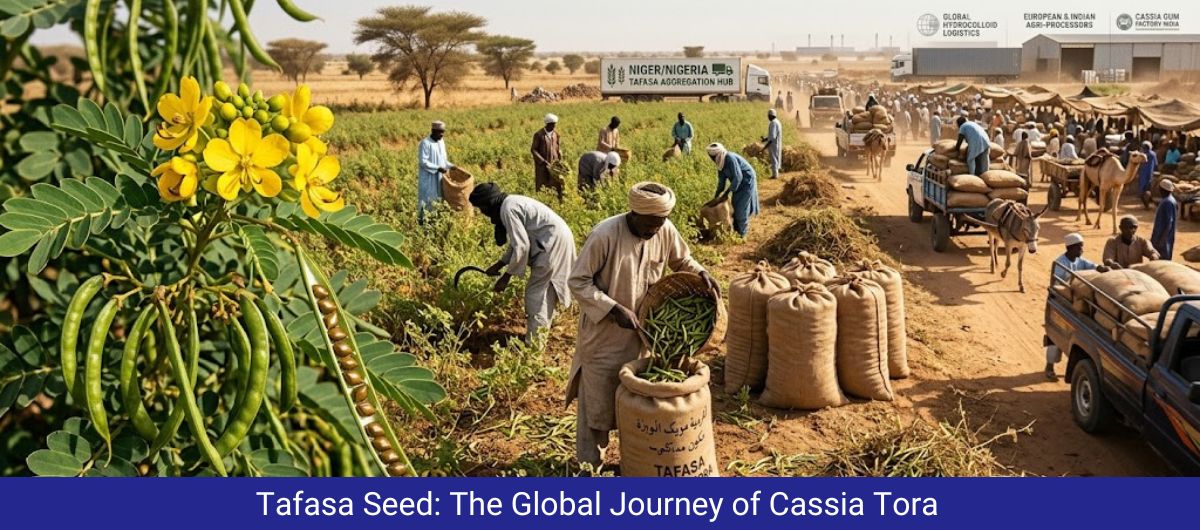
In the rural markets of northern Nigeria and the farming communities of Niger, a familiar wild plant is harvested every year — a shrub known locally as tafasa. Its small oval seeds, dried under the sun, are collected and sold to traders who aggregate them in burlap sacks for transport to regional markets. For most people involved in this supply chain, tafasa is simply a local crop traded for modest prices in regional commodity markets. The global destination of those seeds — European pet food factories, Indian hydrocolloid processing plants, Chinese pharmaceutical companies — is largely invisible from the point of harvest. This article pulls back the curtain on the full story: what tafasa is in scientific and commercial terms, how it connects local African agriculture to global manufacturing, what it is used for, and why its commercial value has grown significantly over the past two decades.
The Botanical Identity of Tafasa
Tafasa is the Hausa-language name for Cassia tora, a species of annual leguminous plant in the family Fabaceae. Modern botanical taxonomy has reclassified the plant as Senna tora, though the older name Cassia tora remains dominant in commercial, regulatory, and agricultural literature. A closely related species, Cassia obtusifolia (Senna obtusifolia), is often processed alongside Cassia tora and the two are frequently grouped together under the commercial category cassia seeds.
The tafasa plant is a short to medium-height annual herb growing to 60 to 90 centimetres. It is characterised by alternate compound leaves, bright yellow flowers, and elongated, curved seed pods — the sickle shape of these pods gives rise to the English name sickle pod. Each pod contains 20 to 30 small, hard seeds with a glossy surface and distinctive diamond-like cross-section. These seeds are the primary commercial product.
We’re Ready to Help!
 Email Us!
The Full Name Map: Tafasa Across Languages and Cultures
Hausa (Nigeria, Niger, Burkina Faso, Ghana): Tafasa / yayan tafasa
English: Foetid cassia, sickle pod, sickle senna, wild senna, coffee weed
Hindi and Gujarati (India): Chaksu — Sanskrit for eye
Marathi (India): Panwad or pawad
Tamil (South India): Tagarisa
Chinese (TCM): Jue Ming Zi — decision-bright seed
Indonesian / Malay: Biji cassia or ketepeng
French: Casse fetide
Spanish: Semilla de cassia or cassia tora
Portuguese (Brazil): Semente de cassia
Russian: Kassia (kassiya)
Geographic Distribution: A Truly Pantropical Plant
West and East Africa
In Nigeria — the most populous country in Africa — tafasa is found across the Guinea Savannah and Sudan Savannah ecological zones, from the Middle Belt states such as Benue and Kogi northward through Kaduna, Katsina, and Sokoto states. In Niger, Burkina Faso, and northern Ghana, it is similarly widespread across the Sahel transition zone. In East Africa, Uganda, Kenya, and Ethiopia host significant wild populations.
Across African growing zones, harvest of tafasa seeds is primarily opportunistic rather than systematic — seeds are collected from wild-growing plants by rural households as a supplementary income source. The absence of cultivation means that seed quality is highly variable in terms of gum content, moisture, and foreign matter. However, the large geographic spread of wild populations ensures aggregate supply volumes that are commercially significant.
South Asia
India is both a wild-growing habitat and a cultivation zone for cassia tora. The primary cultivation states are Gujarat, Rajasthan, and Madhya Pradesh, where cassia tora is grown as a semi-commercial crop by smallholder farmers. Indian cassia tora seeds consistently have higher galactomannan (gum) content than wild-harvested African seeds — typically 30 to 35 percent versus 20 to 28 percent — due to generations of selection for productive seed populations. This quality advantage makes Indian-origin cassia tora the preferred raw material for premium cassia gum powder production.
Southeast Asia and South America
Indonesia, Malaysia, Thailand, Vietnam, and Cambodia all host cassia tora populations in agricultural margins and disturbed land. In Brazil and Colombia, the plant has naturalised across tropical zones following historical introduction. These populations represent emerging sources of commercial seed supply as global demand growth pushes procurement beyond the traditional India-Africa duopoly.
Our Other Product
Guar Meal (Fodder)The Commercial Journey: From Tafasa Field to Global Product
Stage 1: Harvest and Primary Trade
In Nigeria, harvest of tafasa seeds typically occurs between October and January, coinciding with the dry season when pods mature and dry on standing plants. Rural collectors beat or shake pods to release seeds, which are then sun-dried and cleaned through hand-winnowing. Village-level aggregation by local traders consolidates these small lots into bags of 50 to 100 kilograms for transport to regional commodity markets.
Prices at this level are set by local supply and demand dynamics, with little connection to international cassia gum market prices. This information asymmetry — between local farmers who receive a fraction of the final product value and international buyers who pay for processed gum powder — is a longstanding feature of agricultural commodity supply chains for plant-based ingredients.
Stage 2: Industrial Processing in India
The vast majority of global cassia tora seeds — from both Indian farms and African wild collection — are processed in India, overwhelmingly in Gujarat. The processing chain converts raw seeds into multiple commercial products through seed cleaning, splitting to separate endosperm from germ and husk, endosperm milling to produce cassia gum powder, germ processing to produce cassia tora meal, and husk separation for agricultural use.
This multi-product approach maximises the commercial value extracted from each kilogram of raw seed. A tonne of raw cassia tora seed might yield approximately 300 to 350 kilograms of cassia gum powder, 400 to 450 kilograms of cassia tora meal, and 150 to 200 kilograms of husk — each product stream sold to different market segments.
Stage 3: International Distribution
Finished cassia gum powder is exported from Indian ports to buyers across Europe, North America, Southeast Asia, the Middle East, and Australia. European buyers — predominantly pet food manufacturers and food processing companies — represent the largest value segment. Asian buyers in China, Japan, and Korea purchase both cassia gum powder and standardised cassia seed extracts for food and nutraceutical applications.
Speak with an Expert
 Call Us Now!
Why Global Demand for Tafasa-Derived Products Is Growing
Pet food premiumisation: The global premium wet pet food market grows at 5 to 7 percent annually. Every additional tonne of premium wet dog or cat food requires cassia gum as a gelling agent, creating sustained demand growth.
Clean label ingredient trend: Food manufacturers replacing synthetic additives with natural alternatives consistently identify cassia gum as a preferred plant-derived stabilizer — non-GMO, allergen-free, and with a long history of traditional use.
Locust bean gum substitution: Mediterranean LBG supply constraints are pushing large food manufacturers to qualify cassia gum as an alternative, accelerating demand growth beyond the pet food sector.
Nutraceutical growth: Research interest in cassia seed health properties — particularly for liver health, eye health, and digestive function — is creating new demand from supplement manufacturers in Japan, Korea, China, and increasingly in Western markets.
Avlast Hydrocolloids is a manufacturer, processor, and exporter of cassia tora seeds, cassia tora splits, cassia gum powder, and cassia tora meal from Ahmedabad, Gujarat, India. Established in 2006, we work directly with cassia tora growers across Gujarat and Rajasthan to ensure consistent raw material quality throughout the year. Our processing facility produces food-grade, pet food-grade, and industrial-grade cassia tora products under CGMP conditions. We export to customers in over 30 countries including Nigeria, Uganda, the UK, Germany, France, the USA, Brazil, and across Southeast Asia. Buyers looking to source raw cassia tora seeds, processed splits, or finished cassia gum powder can contact us at www.avlasthydrocolloids.com.
Frequently Asked Questions
What is the English name for tafasa seed?
Tafasa (Hausa) is Cassia tora in botany. English names include foetid cassia, sickle pod, sickle senna, wild senna, and coffee weed. In India it is called chaksu or panwad.
What are tafasa seeds commercially used for?
Tafasa seeds are the raw material for cassia gum powder (E427) — a food hydrocolloid used in pet food, food processing, textiles, paper, and oil drilling. The germ by-product (cassia tora meal) is used as a protein supplement in animal feed.
Why does India dominate cassia tora processing?
India combines a large cultivation area producing high-quality seeds with decades of investment in hydrocolloid processing infrastructure and established export logistics. This combination has created a competitive moat that other countries have found difficult to replicate.
Are African tafasa seeds the same quality as Indian seeds?
Both are the same species, but Indian cultivated cassia tora typically has higher and more consistent gum content (30 to 35 percent) than wild-harvested African seeds (20 to 28 percent). This difference affects raw material value and final product quality.
Can I export raw tafasa seeds from Nigeria to India?
Yes. Raw cassia tora seeds are an established export commodity from Nigeria and other African countries to Indian processors. Avlast Hydrocolloids can advise on raw seed specifications. Contact www.avlasthydrocolloids.com for details.
What is the global market size for cassia gum powder?
The global cassia hydrocolloid market is valued at several hundred million USD annually and is growing at 5 to 8 percent per year, driven primarily by pet food and food processing demand in Europe and North America.
Where can I source processed cassia tora products in bulk?
Avlast Hydrocolloids in Ahmedabad, India supplies cassia tora seeds, splits, gum powder, and meal to international buyers in over 30 countries. Visit www.avlasthydrocolloids.com for product range, specifications, and export pricing.
Share At:




Listen to the Audio Version
0:00 /
0:00