
What Is Cassia Powder? Meaning, Uses, and Industrial Applications Explained
AI Summary — Key Takeaways
- Cassia powder is derived from the seeds of Cassia tora and Cassia obtusifolia — leguminous plants grown across India, Africa, and Southeast Asia.
- It serves as a natural thickener, stabilizer, gelling agent, and emulsifier across food, pet food, textile, paper, and oil drilling industries.
- The refined endosperm fraction is sold as cassia gum powder (E499) — approved by the EU and used in food manufacturing globally.
- Cassia gum is non-GMO, allergen-free, and has a neutral taste, making it ideal for sensitive food formulations.
- India — specifically Ahmedabad in Gujarat — is one of the world’s leading hubs for cassia gum powder manufacturing and export.
- Avlast Hydrocolloids is a leading manufacturer, processor, and global supplier of cassia gum powder, exporting to 30-plus countries since 2006.
If you have come across the term cassia powder in an ingredient list, a technical specification sheet, or a product formulation guide, you may have wondered: what exactly is it, and why does it appear in such a wide variety of products — from ice cream to pet food to textile dyes? The answer spans botany, food science, industrial chemistry, and global trade. Understanding cassia powder fully can open significant sourcing and formulation opportunities for businesses across multiple industries.
This article covers everything: what cassia powder is, where it comes from, what makes it so useful industrially, its regulatory status around the world, and how global buyers can source reliable supply.
The Botanical Origin of Cassia Powder
Cassia powder is produced from the seeds of Cassia tora — also known as Senna tora — and Cassia obtusifolia, annual leguminous plants that belong to the Fabaceae family. These plants are native to tropical and subtropical regions of Asia and Africa and grow abundantly across India, Ethiopia, Nigeria, and parts of Southeast Asia including Indonesia, Vietnam, and Thailand.
In India, the plant is semi-cultivated as a cash crop across Gujarat, Rajasthan, and Madhya Pradesh. Farmers harvest the seed pods between October and December each year. The pods are then dried and processed to extract the seeds, which are the raw material for all cassia-derived commercial products.
The cassia tora plant is a hardy annual that grows in a range of soil types, including poor, degraded soils unsuitable for food crops. This makes it an important source of income for smallholder farmers and rural communities across India and Africa. The seeds contain three economically valuable fractions: the husk, the endosperm, and the germ — each of which has commercial applications.
Cassia Tora Powder vs Cassia Gum Powder: Key Differences
These two terms are used interchangeably in casual conversation but refer to distinct products in the manufacturing world:
Cassia tora powder: A broader milling product that incorporates the whole seed or multiple seed fractions. It is used in textile printing as a thickener, in animal feed as a protein and fibre supplement, and in Ayurvedic and herbal preparations. Cassia tora powder typically has a darker colour and lower galactomannan content than refined cassia gum.
Cassia gum powder (E499): A highly refined endosperm extract with a galactomannan content typically between 75 and 85 percent. It is cream-white in colour, nearly odourless, and has excellent water-binding and viscosity-building properties. This is the food-grade and pet food-grade product that meets EU and international regulatory standards.
The distinction matters significantly for buyers. A food manufacturer specifying cassia gum powder E499 for an ice cream stabilizer system needs the refined, high-galactomannan product — not raw cassia tora powder used in textile mills. Understanding this difference before sourcing is essential.
The Chemistry Behind Cassia Gum’s Industrial Value
The industrial usefulness of cassia gum powder is rooted in its molecular structure. Galactomannans — the polysaccharides that make up most of cassia gum’s dry weight — consist of a linear backbone of mannose units with galactose side chains attached at regular intervals. The ratio of mannose to galactose in cassia gum is approximately 5:1, which gives it specific gelling and viscosity properties distinct from other galactomannans like guar gum (approximately 2:1) and locust bean gum (approximately 4:1).
This higher mannose-to-galactose ratio means cassia gum can interact powerfully with other polysaccharides — especially kappa-carrageenan — to form firm, elastic gels. This is the basis of its dominance in the wet pet food stabilizer market, where gel texture and chunk stability are essential product attributes.
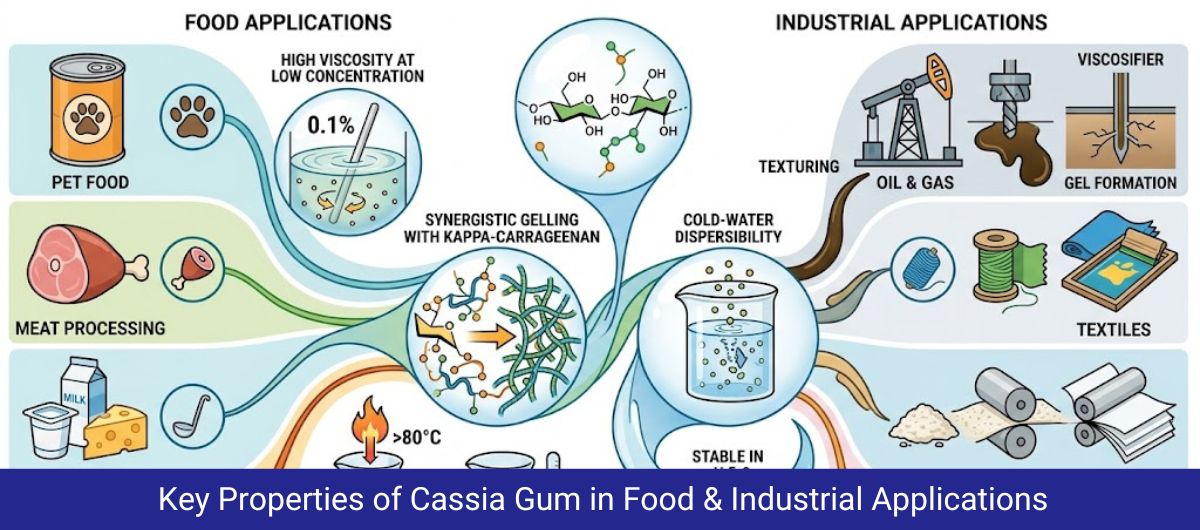
Key Functional Properties
High viscosity at low concentration: Cassia gum forms viscous solutions at concentrations as low as 0.1 percent, making it cost-effective in large-volume food production.
Synergistic gelling: In combination with kappa-carrageenan, cassia gum forms gels significantly stronger than either ingredient alone — a property exploited in pet food, dairy, and meat formulations.
Thermal stability: Cassia gum hydrates best at temperatures above 80 degrees Celsius and retains its viscosity through subsequent cooling and retort sterilisation processes.
Cold-water dispersibility: Unlike many industrial gums, cassia gum can partially hydrate in cold water — useful in applications where hot processing is not possible.
pH stability: Effective across a pH range of 5 to 9, covering the majority of food and industrial applications.
Neutral sensory profile: Tasteless and odourless — essential for food applications where any off-note would be unacceptable.
Non-GMO and allergen-free: Cassia is not genetically modified and contains no proteins associated with common food allergens such as gluten, dairy, or soy.
Industrial Applications of Cassia Powder — Sector by Sector
Food and Beverage Industry
In food manufacturing, cassia gum powder functions as a multi-purpose stabilizer. In frozen desserts such as ice cream and sorbet, it prevents ice crystal formation during freeze-thaw cycles, maintaining smooth texture and extended shelf life. In processed cheese, it controls water migration and improves slice integrity. In meat products such as sausages and pates, it acts as a water binder, reducing cooking losses and improving juiciness.
In bakery applications, cassia gum improves dough consistency, extends freshness by retaining moisture, and is particularly valuable in gluten-free bread formulations where it partially compensates for the texture-building role normally played by gluten. In salad dressings, sauces, and beverages, it acts as a suspending and stabilizing agent preventing phase separation during storage.
Pet Food Industry
The pet food sector is one of the largest and fastest-growing end markets for cassia gum powder globally. Premium wet dog food and cat food — in canned, pouch, and tray formats — use cassia gum as a gelling agent and texture stabilizer. It creates the firm jelly around meat chunks, the smooth gravy in wet formulations, and the cohesive structure of pate-format products. Its synergy with carrageenan allows pet food manufacturers to achieve excellent texture at lower ingredient costs, with the additional benefit of using a natural, plant-derived ingredient that resonates with increasingly health-conscious pet owners.
Textile Printing Industry
Cassia tora powder has a long history in the textile printing industry, where it functions as a print paste thickener for reactive and pigment dyes. In cotton and blended fabric printing, the thickener controls dye penetration, prevents colour bleeding, and enables sharp print definition. Cassia tora powder provides excellent rheological properties — it creates print pastes that flow easily under shear (during printing) but hold their shape on the fabric after printing, ensuring clean patterns and minimal waste.
Paper Manufacturing
In paper production, cassia gum powder is applied as a surface sizing agent, improving paper strength, enhancing ink receptivity, and reducing surface porosity. It acts as a binding agent in the fibre matrix and can partially substitute for more expensive synthetic polymers like polyvinyl alcohol in certain paper grades. Its natural origin also appeals to manufacturers producing environmentally certified paper products.
Oil and Gas Drilling
Industrial-grade cassia gum — sometimes blended with guar gum — is used in water-based drilling mud formulations. Its high molecular weight and exceptional water-retention capacity make it valuable for controlling mud viscosity, preventing fluid loss into the formation, and carrying drill cuttings to the surface during oil well drilling operations. Demand from the oil and gas sector has historically been a significant driver of the broader hydrocolloid market.
Animal Feed and Agriculture
Cassia tora meal — the protein-rich germ fraction separated during gum powder production — is a valuable by-product used in cattle feed, poultry feed, and aquaculture. With a crude protein content of 25 to 30 percent, cassia tora meal serves as a cost-effective alternative to soybean meal, particularly relevant given the price volatility of soybean on global commodity markets. This dual revenue stream from both the endosperm (gum) and the germ (meal) makes cassia tora processing economically attractive.
Regulatory Status of Cassia Gum Powder Around the World
Understanding the regulatory landscape is essential for food manufacturers and importers working with cassia gum:
European Union: Cassia gum is approved as food additive E499 under EU Regulation No 1333/2008. It is permitted in specific food categories including canned and bottled fruits and vegetables, jam and marmalade, and pet food. The European Food Safety Authority (EFSA) conducted a full safety assessment and confirmed its safety at specified usage levels.
United States: Cassia gum is not listed as a direct food additive by the FDA, but it is used in the US market in pet food and industrial applications. Refined cassia gum meeting food-grade specifications is used in certain applications in accordance with FDA guidelines.
Australia and New Zealand: Cassia gum is permitted under Food Standards Australia New Zealand (FSANZ) frameworks for certain food categories.
International: In many countries, cassia gum’s use in food is evaluated on the basis of its E499 EU status or on a product-specific basis through local food safety authorities.
For manufacturers supplying to EU markets, sourcing cassia gum powder from suppliers who can provide full traceability documentation, specification sheets, and Certificates of Analysis aligned with EU food additive specifications is non-negotiable.
 Call Now!
Global Supply Chain: Why India Dominates Cassia Gum Production
India accounts for the vast majority of global cassia gum powder production and export, for several reinforcing reasons. First, cassia tora grows abundantly across India’s semi-arid agricultural belt, providing a large and diversified raw material base. Second, decades of investment in processing technology have created highly efficient separation and milling infrastructure concentrated in Gujarat — particularly Ahmedabad — and Rajasthan. Third, India’s logistics infrastructure — with multiple major ports including Mundra, Kandla, and Nhava Sheva — enables cost-effective export to all major markets.
This supply chain maturity means that Indian manufacturers can offer consistent product quality, large volumes, competitive pricing, and shorter lead times compared to processors in other countries. For international buyers, partnering with an established Indian manufacturer is typically the most reliable path to securing cassia gum supply.
About Avlast Hydrocolloids: Founded in 2006 and headquartered in GIDC Estate, Vatva, Ahmedabad, Gujarat, Avlast Hydrocolloids is a leading manufacturer, processor, and exporter of cassia gum powder, cassia tora powder, cassia tora splits, cassia tora meal, and guar gum powder. With direct sourcing relationships with cassia and guar growers across India and a modern processing facility compliant with CGMP and SSOP standards, Avlast supplies food-grade, pet food-grade, textile-grade, and industrial-grade products to customers in over 30 countries including the USA, UK, France, Germany, Brazil, Australia, Turkey, and across Southeast Asia. All products come with full documentation including Certificates of Analysis, specification sheets, and regulatory compliance letters. For sourcing enquiries, samples, and export pricing, visit www.avlasthydrocolloids.com or call +91-79-25830618.
Frequently Asked Questions
Is cassia powder the same as cinnamon?
No. Although both words are associated with the cassia family, cassia powder used industrially is derived from Cassia tora seeds — a leguminous plant from the Fabaceae family. Culinary cinnamon or cassia comes from the bark of Cinnamomum cassia, a completely different plant from the Lauraceae family. They are chemically and functionally unrelated products.
What is the food additive number for cassia gum powder?
Cassia gum powder is designated E499 in the European Union’s food additive numbering system. This means it has been evaluated for safety by the European Food Safety Authority and is approved for use in specified food categories.
Is cassia gum powder safe for human consumption?
Yes. Purified food-grade cassia gum powder (E499) has been evaluated by EFSA and is approved for use in food at specified levels. It is produced under CGMP and SSOP conditions to ensure microbiological safety and product purity. It is also non-GMO and free from common allergens.
What is the difference between cassia gum powder and guar gum powder?
Both are galactomannan polysaccharides, but they have different mannose-to-galactose ratios, which gives them different functional properties. Cassia gum (ratio approximately 5:1) forms strong gels with carrageenan and is preferred in pet food. Guar gum (ratio approximately 2:1) is a more powerful general thickener and is widely used in food, cosmetics, textiles, and oil drilling.
What industries use cassia tora powder as opposed to cassia gum powder?
Cassia tora powder (a broader milling product) is primarily used in textile printing and animal feed. Cassia gum powder (refined endosperm) is used in food processing, pet food, paper manufacturing, and nutraceuticals. Understanding this distinction is important for procurement teams.
Where can I source food-grade cassia gum powder in bulk?
Avlast Hydrocolloids in Ahmedabad, India is a leading manufacturer and exporter of food-grade cassia gum powder supplying to 30-plus countries. They offer multiple viscosity grades, full quality documentation, and export-ready packaging. Visit www.avlasthydrocolloids.com for specifications and enquiries.
What certifications should a cassia gum supplier hold?
Look for ISO certification, CGMP compliance, SSOP documentation, Halal and Kosher certification where required by your market, and the ability to provide a Certificate of Analysis with each batch. Suppliers should also be able to provide regulatory compliance letters for your target market.