
Read Our Article
How to Use Cassia Gum Powder in Homemade Desserts and SaucesCassia Gum as a Locust Bean Gum Substitute: The Complete Guide for Food Manufacturers
AI Summary — Key Takeaways
- Cassia gum (E427) and locust bean gum (E410) are both galactomannans — making cassia gum a technically sound substitute in most food applications.
- Cassia gum’s higher mannose-to-galactose ratio of 5:1 gives it stronger synergy with carrageenan than LBG, often delivering superior gel performance.
- Direct substitution at 1:1 ratio is a reliable starting point, with minor adjustments for gel-critical products.
- Key applications include wet pet food, dairy, processed meats, gluten-free bakery, and sauces and dressings.
- Indian cassia gum supply is more price-stable and volume-reliable than Mediterranean-sourced locust bean gum.
- Avlast Hydrocolloids supplies refined food-grade and pet food-grade cassia gum powder in multiple viscosity grades suitable for LBG substitution.
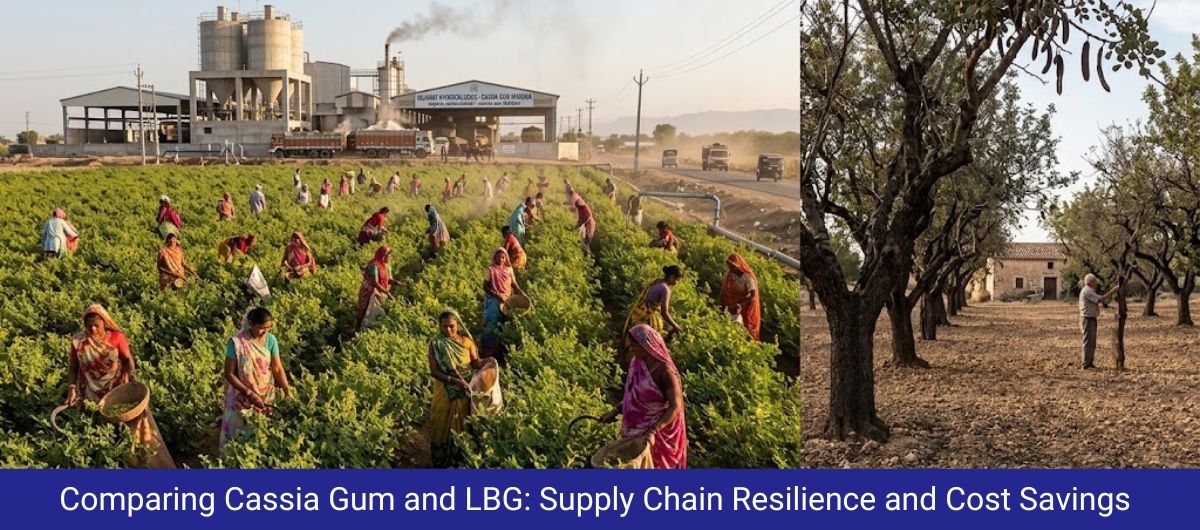
The global food ingredients market has been watching the locust bean gum (LBG) supply chain with increasing concern. Carob trees — the source of LBG — grow almost exclusively in Mediterranean countries including Spain, Italy, Portugal, Morocco, and Greece. A combination of climate variability, an ageing tree population that takes 15 to 20 years to reach full productivity, and competing demand from the food and feed industries has created recurring supply shortages and significant price volatility. For food manufacturers using LBG in their stabilizer systems — particularly in pet food, dairy, and processed meats — this has elevated supply security to a strategic boardroom concern.
Cassia gum powder, derived from the seeds of Cassia tora grown abundantly across India, has emerged as the most technically credible and commercially attractive alternative. This guide is for food technologists and procurement professionals exploring the substitution.
The Galactomannan Family: Why Cassia Gum Works as a Substitute
Both cassia gum and locust bean gum belong to the galactomannan polysaccharide family. Their backbone is a linear chain of beta-1,4-linked mannose units with alpha-1,6-linked galactose side chains. The critical variable between galactomannans is the mannose-to-galactose (M:G) ratio, which determines how frequently galactose branches interrupt the mannose backbone.
Unsubstituted sections of the mannose backbone drive synergistic interactions with other polysaccharides — particularly the helical structures of kappa-carrageenan — that produce gel formation. The more unsubstituted mannose regions, the stronger the carrageenan interaction:
Guar gum (M:G approximately 2:1): Heavily substituted, excellent thickener but limited carrageenan gel synergy.
Locust bean gum E410 (M:G approximately 4:1): Moderately substituted, strong carrageenan synergy, widely used in pet food and dairy.
Cassia gum E427 (M:G approximately 5:1): Less substituted, strongest carrageenan synergy among the three — often forms firmer gels than LBG at equivalent dosage.
This structural advantage means cassia gum is not merely an equivalent substitute for LBG — in many gel-forming applications, it can outperform LBG while allowing manufacturers to reduce total stabilizer inclusion.
Call Now for Instant Assistance!
 Call Now
Application-by-Application Substitution Guide
Wet Pet Food: Chunks in Jelly and Pate Formats
This is the highest-volume and most technically demanding substitution scenario. Premium wet pet food manufacturers use LBG at concentrations of 0.15 to 0.4 percent in combination with kappa-carrageenan at 0.2 to 0.5 percent to achieve jelly or gravy textures in retort-sterilised products. The combined stabilizer system must survive temperatures exceeding 120 degrees Celsius during retort processing and form a stable gel upon cooling that holds throughout a two to three year shelf life.
Cassia gum substitutes directly at a 1:1 ratio in this application. In many formulations, the stronger carrageenan synergy of cassia gum allows maintaining or improving gel firmness while reducing total stabilizer inclusion by 5 to 15 percent — a meaningful cost saving at scale. A standard reformulation trial protocol would include bench-scale gel tests, retort simulation at the production sterilisation cycle, and texture profile analysis of the cooled product versus the LBG standard.
Dairy Products: Ice Cream, Yoghurt, and Processed Cheese
In ice cream, LBG prevents recrystallisation of ice crystals during storage and distribution, contributing to smooth texture and reduced sandiness after freeze-thaw cycling. It also slows the meltdown rate. Cassia gum performs these functions equivalently at a 1:1 substitution. Formulators should ensure cassia gum is incorporated above 80 degrees Celsius during pasteurisation for full hydration and maximum viscosity development.
In yoghurt and fermented dairy, LBG prevents syneresis during storage. Cassia gum provides equivalent water-binding performance. In processed cheese, both ingredients contribute to emulsification and sliceability — cassia gum works equivalently at the same concentration level as LBG in the formulation.
Processed Meat Products
In sausages, frankfurters, and meat pates, LBG acts as a water binder and texture improver, reducing cooking losses and improving product juiciness and cohesion. Cassia gum can be substituted directly at a 1:1 ratio. Reformulation trials should use the exact salt and phosphate levels of the production formula, as high ionic strength affects galactomannan hydration behaviour.
Gluten-Free Bakery
LBG is used in gluten-free bread to partially compensate for the structural role of gluten, improving dough handling, oven spring, crumb structure, and moisture retention. Cassia gum is an effective substitution — begin with a 1:1 ratio and adjust water content by 1 to 2 percent if required. Cassia gum’s stronger water-binding capacity relative to LBG may affect dough handling characteristics at higher inclusion levels.
Sauces, Dressings, and Ready Meals
In emulsion-based sauces and dressings, both LBG and cassia gum serve as stabilizers preventing phase separation during storage. In ready meal gravies and cooking sauces, they provide appropriate flow behaviour. Cassia gum is a direct 1:1 drop-in replacement in these applications, with pH stability across 5 to 9 covering the range of this product category.
Practical Formulation Guidelines for the Switch
For food technologists managing the transition:
Start at 1:1: Replace LBG with cassia gum at the same dosage in your current formulation as the baseline trial.
Optimise for gel: In carrageenan-containing systems, explore reducing total stabilizer by 5 to 10 percent — cassia gum’s stronger synergy may allow this while maintaining gel performance.
Hydration temperature: Incorporate cassia gum above 80 degrees Celsius for maximum viscosity development.
pH check: Cassia gum is stable across pH 5 to 9 — confirm compatibility with the acidity of your specific formulation.
Microbiological specification: Confirm that your cassia gum supplier’s microbiological specification matches your ingredient requirements — particularly for retort pet food and dairy applications.
Regulatory confirmation: Confirm E427 compliance documentation from your supplier before launching reformulated product in EU markets.
Our Other Product
Guar Gum PowderThe Commercial Case: Why Switch Now
The commercial rationale for substituting cassia gum for LBG has strengthened considerably over recent years. LBG prices have shown significant volatility as Mediterranean carob harvests fluctuate with growing season conditions. Since carob trees cannot be rapidly replanted and take 15 to 20 years to reach productive maturity, supply cannot be quickly expanded in response to demand increases — a structural constraint that keeps prices elevated.
Cassia tora, as an annual crop grown across a large agricultural belt in India, responds to demand signals within a single growing season. India’s well-developed hydrocolloid processing infrastructure in Gujarat and Rajasthan enables rapid volume scaling. For procurement teams managing ingredient supply risk, this supply chain resilience represents significant risk mitigation compared to a single-region Mediterranean source.
At recent market prices, switching from LBG to cassia gum typically reduces ingredient cost by 20 to 40 percent — a substantial saving for high-volume food manufacturers, particularly in the pet food sector where stabilizer systems are used in every unit of production.
Avlast Hydrocolloids is a leading manufacturer, processor, and exporter of refined cassia gum powder from Ahmedabad, India. Our cassia gum is produced from high-quality Cassia obtusifolia and Cassia tora endosperm under CGMP conditions, with full microbiological testing and EU E427 compliance documentation available for each batch. We supply food-grade and pet food-grade cassia gum in multiple viscosity grades to manufacturers in Europe, the USA, Australia, Brazil, Turkey, Southeast Asia, and the Middle East. Technical application support including cassia gum and carrageenan ratio optimisation guidance is available to our customers’ formulation teams. To request samples, technical data sheets, and export pricing, visit www.avlasthydrocolloids.com.
Quick Response Guaranteed
Contact Us!
Frequently Asked Questions
Is cassia gum approved in the EU as a food additive?
Yes. Cassia gum is approved under EU food additive regulation as E427. It has been evaluated for safety by the European Food Safety Authority (EFSA) and is permitted in specific food categories, including canned vegetables, jam, processed meat, pet food, and others.
Can cassia gum replace locust bean gum at exactly the same dosage?
In most applications, a 1:1 substitution is a reliable starting point. Due to cassia gum’s stronger carrageenan synergy, some gel-forming applications may achieve equivalent or better texture at 85 to 95 percent of the LBG dosage, offering additional cost savings.
Does cassia gum taste or smell different from locust bean gum?
No. Both cassia gum and LBG are tasteless and odourless at food-grade purity levels. There is no sensory impact of the substitution in any application.
Why is cassia gum generally cheaper than locust bean gum?
Cassia tora is an annual crop grown across a large agricultural belt in India, offering stable and scalable supply. LBG comes from carob trees that take 15 to 20 years to mature and grow only in Mediterranean countries, creating inherent supply constraints and price volatility.
Is cassia gum safe for use in pet food products?
Yes. Cassia gum is widely used in premium European and North American wet pet food at usage levels of 0.2 to 0.5 percent. It is considered safe for both dogs and cats at these levels and is permitted under EU regulations for animal nutrition.
What viscosity grades of cassia gum are available for food use?
Cassia gum is available in multiple viscosity grades, typically ranging from standard food grade to high viscosity pet food grade. Avlast Hydrocolloids can provide customised grades matched to your existing LBG specification.
How quickly can I get samples and start formulation trials?
Avlast Hydrocolloids can provide samples within a few weeks of request. Visit www.avlasthydrocolloids.com to submit a sample request and receive technical documentation.
Share At:




Listen to the Audio Version
0:00 /
0:00