
Read Our Article
Cassia Tora Meal vs. Soybean Meal: Which is Better for Cattle Feed?Guar Meal vs Cassia Meal: Choosing the Right Feed Binder for Cattle and Poultry
Two seed processing by products with different jobs: guar meal brings protein, cassia meal brings binding and texture.
AI Summary
- Guar meal and cassia meal are both by products of gum extraction but serve different primary roles in feed.
- Guar meal is protein rich, around fifty percent protein, and is used to lift the nutritional value of cattle and livestock rations.
- Cassia meal is a natural thickening and binding agent that improves feed consistency, palatability and nutrient distribution.
- For cattle, guar meal can improve milk fat and yield; cassia meal binds and texturises the feed and is used with xanthan gum in wet canned formats.
- They are complementary, not competing: many rations draw protein from guar meal and binding from cassia meal.
Feed manufacturers working with natural by products of the gum industry have two closely related materials to consider: guar meal and cassia meal. Both are derived from seed processing, both are valued in animal nutrition, and both are often discussed in the same breath. Yet they serve different primary roles in a feed formulation. Guar meal is prized chiefly for its protein, while cassia meal is valued mainly as a natural binder and thickener. Understanding the difference helps feed producers choose the right material, or the right combination, for cattle and poultry rations.
This article compares guar meal and cassia meal across origin, composition, function and best use, so formulators can make an informed choice.
Where Guar Meal and Cassia Meal Come From
Both meals are by products of gum extraction, but from different plants.
Guar meal is produced during the manufacture of guar gum from the guar bean, Cyamopsis tetragonoloba. When the seed is processed to extract the gum bearing endosperm, the remaining germ and husk fractions are recovered and processed into guar meal, sometimes referred to in its different forms as guar churi and guar korma. This meal is notable for its high protein content.
Cassia meal comes from the processing of Cassia tora seed into cassia gum and cassia splits. The fraction left after the gum bearing portion is separated is processed into cassia meal. It carries the thickening and binding character of the cassia plant, which is why it is used primarily as a functional binder in feed.
Need More Information?
 Email Us Today!
Composition and Nutritional Profile
The clearest difference between the two meals is nutritional. Guar meal is a protein rich material, containing around fifty percent protein. In fact guar meal contains roughly twice the protein of a whole guar seed, because the protein is concentrated in the germ fraction recovered during processing. This high protein density is what makes guar meal a genuine nutritional ingredient rather than just a functional additive.
Cassia meal, by contrast, is valued less for protein and more for its functional behaviour as a natural thickening and binding agent. Its contribution to a ration is structural and textural rather than primarily nutritional. It is also used in conjunction with xanthan gum as a thickening agent in wet canned applications, which points to its binder identity.
In short, guar meal brings protein to the formula, while cassia meal brings binding and consistency. This single distinction drives most of the decisions around which to use.
Function in Cattle Feed
For cattle and buffalo, the two meals play complementary roles.
Guar meal acts as a protein rich feed additive that supports the digestive system of cows and buffaloes. Producers report that cattle fed guar meal can give richer milk with more fat and, in many cases, an increase in milk quantity. Because the meal carries about twice the protein of the guar seed itself, it is widely used in cattle feed as an economical protein source that improves the overall nutritional value of the ration.
Cassia meal serves cattle feed as a natural thickening and binding agent. By improving the consistency of the feed, it enhances palatability and supports nutrient absorption, helping ensure that the ration holds together and that cattle consume it readily. Where guar meal raises the protein level, cassia meal improves the physical quality and uniformity of the feed.
Function in Poultry Feed
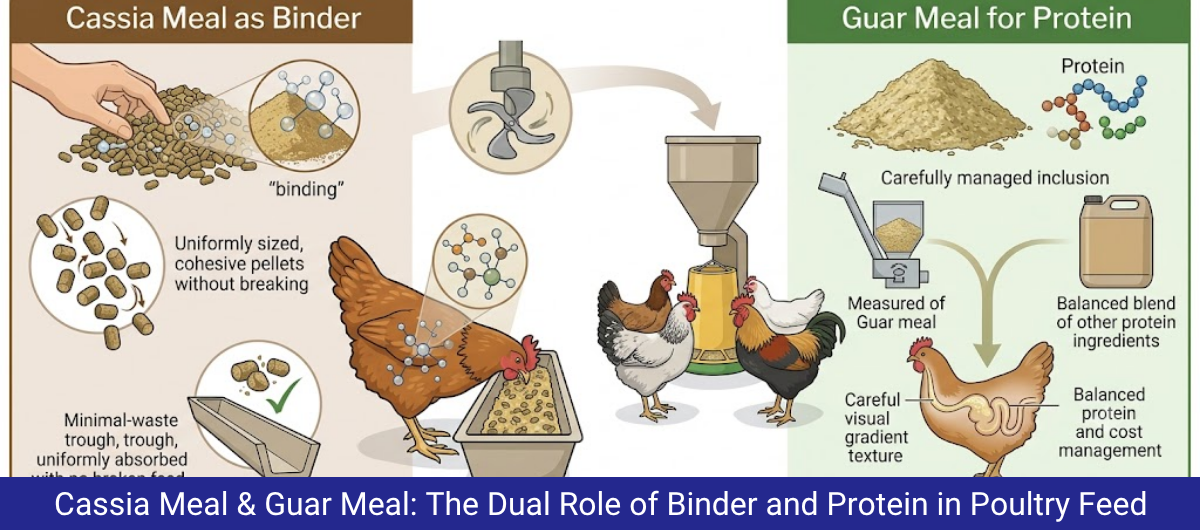
In poultry rations the same division of labour applies. Cassia meal contributes as a binder that improves the texture and consistency of feed, helping ensure uniform distribution of nutrients through the mix. Even, cohesive feed reduces wastage and supports consistent intake across the flock. Guar meal, where used in poultry, contributes its protein, though inclusion levels are typically managed carefully because of the residual gum content, which can affect feed viscosity in the bird if overused.
For many poultry formulations the practical answer is to use cassia meal for binding and texture while sourcing protein from a balanced blend of ingredients, with guar meal contributing where its protein and cost profile fit.
Guar Meal vs Cassia Meal at a Glance
The two materials are best understood as complementary rather than competing. The summary below captures the core differences.
- Primary role. Guar meal is a protein source. Cassia meal is a binder and thickener.
- Protein content. Guar meal is high in protein at around fifty percent. Cassia meal is valued for function rather than protein.
- Source plant. Guar meal comes from the guar bean. Cassia meal comes from Cassia tora seed.
- Effect on cattle. Guar meal can improve milk fat and yield. Cassia meal improves feed consistency, palatability and nutrient absorption.
- Effect on feed structure. Guar meal enriches the ration nutritionally. Cassia meal binds and texturises it.
- Typical pairing. Cassia meal is used with xanthan gum as a thickener in wet canned feed. Guar meal is used as a protein rich additive across feed types.
Our Other Product
Fast Hydration Guar Gum PowderChoosing the Right Meal for Your Formulation
The choice between guar meal and cassia meal, or the decision to use both, comes down to what the formulation needs.
- If you need protein, guar meal is the stronger choice. Its high protein content makes it an economical way to lift the nutritional value of cattle and livestock feed.
- If you need binding and texture, cassia meal is the right tool. It improves consistency, palatability and nutrient distribution without relying on synthetic binders.
- If you need both, use them together. A ration can draw protein from guar meal while cassia meal binds the mix into a uniform, palatable feed.
- Match grade to application. For wet canned and high moisture feeds, cassia meal paired with xanthan gum gives strong binding. For dry and pelleted feeds, both meals can contribute according to the protein and texture targets.
For most producers the smartest approach is not to pick one over the other but to use each for what it does best, building a ration that is both nutritionally sound and physically consistent.
Cassia Meal and Guar Meal in Wet Canned Pet Food
While the cattle and poultry uses are the headline applications, both meals also feature in the pet food industry, and the contrast there is instructive. Cassia meal is used as a thickening agent in conjunction with xanthan gum in wet canned pet food, where the two work together to build the gel structure that gives canned products their set, sliceable body and that prevents the watery separation buyers dislike. This is a clear illustration of cassia meal in its binder and thickener role.
Guar meal and guar derived materials, by contrast, tend to contribute on the nutritional and viscosity side. The same protein density that makes guar meal valuable in cattle feed has relevance wherever a protein contribution is wanted, though inclusion is managed to control viscosity effects. Seeing both meals side by side in pet food underlines the central point of this comparison: cassia meal builds structure, guar meal builds nutrition, and a well designed product often uses each for its strength.
Sustainability and the Value of By Product Utilisation
There is a sustainability story behind both meals that is worth recognising. Each is a by product of gum manufacturing. When guar gum is extracted from the guar bean and cassia gum from the Cassia tora seed, the fractions left behind could be treated as waste. Instead they are processed into valuable animal feed ingredients. This turns what would be a disposal problem into a useful, protein rich or functionally active material, improving the overall efficiency and sustainability of the gum industry.
For feed producers, this by product origin has practical advantages. It supports a steady supply linked to gum production, and it gives the feed a natural, plant derived character that fits clean label and sustainability expectations in animal nutrition. Using guar meal and cassia meal is therefore not only a nutritional and functional choice but also a resource efficient one, making good use of materials that already exist within the agricultural processing chain.
Our Other Product
Cassia Tora SeedsInclusion Rates and Feed Formulation Practicalities
Choosing between the meals is only the first step. Getting the best from them depends on sensible formulation practice.
- Guar meal protein contribution. Because guar meal is around fifty percent protein, it can meaningfully raise the protein level of a ration at a modest inclusion. Formulators balance it against other protein sources to hit the target without overshooting cost or viscosity.
- Managing residual gum. Guar meal carries some residual gum, which can raise digesta viscosity if used at very high levels, particularly in poultry. Inclusion is therefore calibrated to capture the protein benefit while keeping viscosity effects in check.
- Cassia meal binding dose. Cassia meal is used at the level needed to achieve the wanted feed consistency and binding. As a functional ingredient, a modest, well judged dose delivers the texture improvement.
- Combination strategy. Where both are used, the formulation draws protein from guar meal and binding from cassia meal, with each set at the level that suits its role.
Trialling inclusion rates in small batches and assessing the resulting feed for consistency, palatability and performance is the surest way to settle on the right levels for a given operation.
Let’s Discuss! Request a Call Now!
 Call Now!
Sourcing Quality Guar Meal and Cassia Meal
The value of either meal depends on consistent quality, defined protein content for guar meal and reliable functional behaviour for cassia meal. Working with an established manufacturer that processes both materials gives feed producers a dependable, single source supply.
Avlast Hydrocolloids manufactures and supplies both guar meal and cassia meal for cattle, buffalo, livestock and poultry feed applications. Whether your formulation needs a protein rich additive, a natural binder or both, the Avlast Hydrocolloids team can help you choose the right material and specification. To discuss your feed application or request a sample, get in touch.
Frequently Asked Questions
What is the difference between guar meal and cassia meal?
Guar meal is a protein rich feed ingredient, around fifty percent protein, derived from guar bean processing. Cassia meal is a natural binder and thickener derived from Cassia tora seed processing. In short, guar meal brings protein while cassia meal brings binding and texture.
Which is better for cattle feed?
It depends on the need. Guar meal is the stronger choice for adding protein and can improve milk fat and yield. Cassia meal is the right tool for improving feed consistency, palatability and nutrient absorption. Many formulations use both for their respective strengths.
Why is guar meal high in protein?
Guar meal contains around fifty percent protein, roughly twice that of a whole guar seed, because the protein is concentrated in the germ fraction recovered during guar gum extraction.
How is cassia meal used in feed?
Cassia meal acts as a natural thickening and binding agent that improves the consistency of cattle and poultry feed, enhancing palatability and supporting uniform nutrient distribution. It is also used with xanthan gum as a thickener in wet canned pet food.
Can guar meal and cassia meal be used together?
Yes, and often they should be. A ration can draw its protein from guar meal while cassia meal binds the mix into a uniform, palatable feed, with each material set at the level that suits its role.
Are these meals sustainable?
Both are by products of gum manufacturing. Rather than being treated as waste, the fractions left after gum extraction are processed into valuable feed ingredients, improving the efficiency and sustainability of the gum industry.
About Avlast Hydrocolloids
Avlast Hydrocolloids is a reputed manufacturer and global distributor of cassia gum powder, guar gum powder and their derivatives, based in Ahmedabad, Gujarat, India. The company processes natural seed gums from raw seed through to finished powder, supplying food grade and industrial grade material to customers across the food, pet food, animal feed, cosmetics, pharmaceutical and industrial sectors worldwide.
Its product range covers cassia gum powder, cassia tora splits, cassia tora meal and cassia tora seed, alongside guar gum powder, fast hydration guar gum powder, guar refined splits and guar meal. With a focus on consistent quality, controlled specifications and dependable export supply, Avlast Hydrocolloids serves manufacturers who need natural thickening, gelling, binding and stabilising solutions they can rely on batch after batch. To discuss specifications or request a sample, contact the Avlast Hydrocolloids team.
Dhaval Patel is the CEO of Avlast Hydrocolloids, a manufacturer, supplier and exporter of hydrocolloid products based in Ahmedabad, India. Avlast Hydrocolloids specializes in Guar Gum and Cassia Gum products, serving customers across food, pet food, animal feed, pharmaceutical, personal care and various industrial applications.
With a strong focus on product quality, consistency and application-specific requirements, Avlast Hydrocolloids offers products including Guar Gum Powder, Fast Hydration Guar Gum Powder, Guar Refined Splits, Cassia Gum Powder, Cassia Tora Splits and other hydrocolloid ingredients. The company serves both domestic and international markets, with a focus on meeting industry-specific quality and performance requirements.
Through its industry-focused content, Avlast Hydrocolloids shares practical and informative insights about guar gum, cassia gum, hydrocolloids, their properties, applications, specifications and use across different industries. The content is intended to provide accurate and useful information for manufacturers, formulators, buyers, importers and other professionals looking to understand hydrocolloid ingredients and their applications.
Share At:




Listen to the Audio Version
0:00 /
0:00