
Read Our Article
Cassia Gum Powder for Emerging Food Applications: Snacks, Sauces and Ready MealsCassia Gum Powder in Wet and Canned Poultry Feed: Texture, Binding and Nutrient Uniformity
A natural galactomannan binder that holds moisture, suspends nutrients and gives wet and canned poultry feed a stable, palatable texture.
AI Summary
- Cassia gum powder is a natural seed galactomannan used in wet and canned poultry feed as a thickening, suspending and binding agent.
- It retains moisture, holds dense nutrients in even suspension and gives feed a cohesive structure that reduces fines, dust and wastage.
- In canned formats it pairs with xanthan gum to form a firm gel that resists syneresis and survives thermal processing.
- Uniform texture supports even nutrient distribution, better palatability and more consistent flock performance.
- Strong functionality at low inclusion rates keeps the binder cost effective while leaving room for nutritional ingredients.
Poultry feed has moved a long way from simple dry mash. As producers chase better palatability, lower wastage and more consistent flock performance, the physical structure of the feed has become as important as its nutritional profile. Wet and canned poultry preparations, feed additives and specialised supplements all depend on a binder that can hold moisture, suspend solids and give the final product a stable, appealing texture. Cassia gum powder, a natural galactomannan derived from the seed of Cassia tora, has earned a place in this category because it does exactly that without introducing synthetic ingredients into the feed chain.
This article looks at how cassia gum powder functions in wet and canned poultry feed, why texture and binding matter for bird performance, and what feed formulators should keep in mind when working it into a recipe.
Why Texture and Binding Matter in Poultry Feed
Texture is not a cosmetic concern in poultry nutrition. The physical form of feed influences how readily birds consume it, how evenly nutrients are distributed through each portion and how much feed ends up wasted on the floor rather than in the bird. In wet and canned formats, a feed that separates into a watery layer and a solid sediment delivers an inconsistent ration from one serving to the next. Birds may get a flush of moisture in one feeding and a dense, dry clump in the next.
A good binder corrects this by holding the components together in a uniform matrix. When fat, protein meals, vitamins and trace minerals are locked into a stable gel structure, each mouthful carries close to the same nutritional load. That uniformity is what supports predictable growth rates and feed conversion ratios, the two numbers poultry producers watch most closely. Cassia gum powder contributes here as a natural thickening and suspending agent, keeping heavier particles from settling and preventing the moisture loss that leads to crumbling and crusting.
We’re Ready to Help!
 Email Us
How Cassia Gum Powder Works as a Feed Binder
Cassia gum is a galactomannan, a long-chain polysaccharide made up of a mannose backbone with galactose side units. When dispersed in water and heated, these chains hydrate and entangle, forming a viscous solution that thickens the surrounding liquid. In poultry feed this translates into three practical effects.
- Moisture retention. The hydrated gum network traps water within the feed matrix, slowing evaporation and keeping wet and canned products from drying at the surface. This is particularly valuable in canned preparations that may sit on a shelf before use.
- Particle suspension. Dense ingredients such as mineral premixes and protein meals tend to sink in a low viscosity slurry. The thickened medium created by cassia gum holds these particles in place, so the ration stays evenly mixed.
- Structural binding. As the gum sets, it gives the feed body and cohesion, reducing fines and dust in additive blends and helping pelleted or moulded forms hold their shape during handling and transport.
A useful feature for feed manufacturers is that cassia gum works in synergy with other hydrocolloids. In wet canned formats it is frequently paired with xanthan gum, where the two interact to build a firmer, more elastic gel than either would form alone. This synergy lets formulators reach a target texture at a lower total gum dose, which has direct cost implications.
Cassia Gum Powder in Canned Poultry Preparations
Canned poultry feed and high moisture poultry products share many of the same formulation challenges seen in canned pet food. The product must survive a thermal process, hold its structure through storage and present a consistent appearance when opened. Syneresis, the weeping of liquid out of a set gel, is a common defect that makes a canned product look watery and unappetising and signals poor moisture control to the buyer.
Cassia gum helps on both fronts. Its gelling behaviour, especially in combination with xanthan, produces a cohesive set that resists syneresis and keeps free liquid bound within the matrix. The result is a canned feed that looks uniform, retains its moisture and delivers a complete ration in every portion. Because cassia gum is heat stable across the temperatures used in canning and retorting, it holds its functionality through the process rather than breaking down.
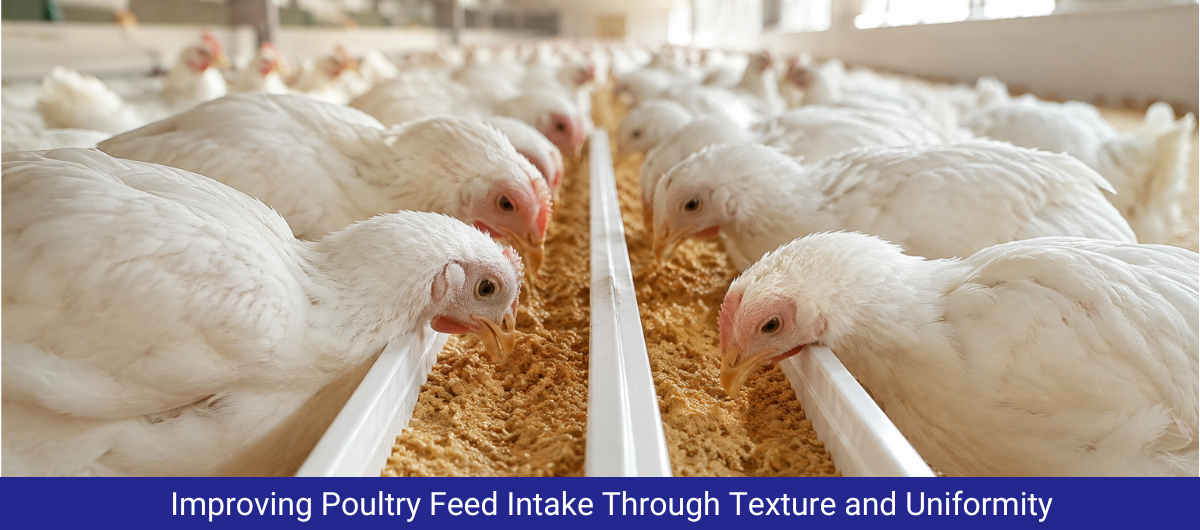
Supporting Nutrient Uniformity and Palatability
Palatability is the bridge between a well designed ration and actual bird performance. A nutritionally complete feed delivers nothing if birds find it unappealing and leave it in the trough. Texture is a major driver of palatability in poultry, and a smooth, cohesive, moist feed encourages steady intake.
By improving the consistency of the feed, cassia gum supports uniform distribution of nutrients across the batch and across each serving. This matters most for the micro ingredients that birds need in small but precise amounts. When vitamins, amino acids and trace minerals are evenly suspended rather than concentrated in pockets, every bird in the flock has access to the same balanced ration. Over a production cycle, that consistency shows up as tighter flock uniformity and more predictable results.
Cassia Gum Versus Synthetic Binders
Feed producers have several binding options, from synthetic polymers to mineral clays to plant gums. Cassia gum sits firmly in the natural, plant derived category, which appeals to operations moving toward cleaner label feed and to export markets with strict input requirements. As a seed gum it is biodegradable and free of the residues sometimes associated with synthetic binders.
Compared with some alternatives, cassia gum also offers strong performance at low inclusion rates. Because galactomannans build viscosity efficiently, a small percentage by weight delivers meaningful thickening and binding. This keeps the binder from displacing nutritionally valuable ingredients in the formula and helps control raw material cost per tonne of feed.
Our Other Product
Cassia Tora MealPractical Guidance for Feed Formulators
Getting the best from cassia gum powder in poultry feed comes down to a few formulation fundamentals.
- Hydration. Cassia gum needs adequate water and usually heat to hydrate fully. Disperse the powder evenly to avoid lumping, and allow time and temperature for the galactomannan chains to develop viscosity before the feed is filled and sealed.
- Dose calibration. Start with a low inclusion rate and adjust upward to reach the target texture. Because the gum is efficient, small changes in dose can produce noticeable differences in firmness, so trial in small batches first.
- Synergy planning. If a firmer or more elastic gel is required, pair cassia gum with xanthan and tune the ratio. The combined system often reaches the desired structure at a lower total gum level than cassia alone.
- Quality consistency. Source feed grade cassia gum with a defined viscosity and particle size specification. Consistent raw material gives consistent feed, batch after batch.
Cassia Gum Powder in Veterinary Preparations and Calf Milk Replacers
Beyond standard poultry rations, cassia gum powder finds use in adjacent animal health products where its suspending and gelling behaviour is equally valuable. In veterinary preparations it acts as a thickening, stabilising and suspending agent, holding active ingredients in even distribution so that each dose delivers a consistent amount. A suspension that settles or separates risks underdosing or overdosing, and a reliable suspending agent prevents that.
In calf milk replacers and similar liquid feeds, the gum helps build a smooth, stable consistency that mixes readily and resists separation during feeding. Animals accept a uniform, well bodied liquid more readily than one that has separated into watery and clumped fractions. The same moisture retention and suspension properties that make cassia gum useful in canned poultry feed carry over directly to these liquid and semi liquid products, which is why the gum is described across veterinary and feed literature as a versatile thickening and suspending agent for animal health applications.
Cost Efficiency and Production Benefits for Feed Manufacturers
For a commercial feed operation, an ingredient is only worth using if it earns its place on a cost per tonne basis. Cassia gum performs well here for a few connected reasons. Because galactomannans build viscosity and structure at low inclusion rates, a small dose by weight delivers the binding and suspension a formulation needs. That efficiency keeps raw material cost down and means the binder occupies very little of the formula, leaving room for nutritionally valuable ingredients.
There are downstream production benefits too. Better binding reduces fines and dust in additive blends, which improves handling, lowers losses and makes for a cleaner manufacturing environment. Improved moisture retention extends the usable life of wet and canned products, reducing spoilage and returns. And the synergy between cassia gum and xanthan gum lets producers reach a target texture at a lower combined gum level than either gum alone would require, trimming cost further. Taken together, these effects mean cassia gum can improve product quality while supporting, rather than straining, the economics of the feed.
Call Now for Instant Assistance!
 Call Now
Quality and Consistency Considerations
Not all cassia gum is equal, and in a feed application the differences matter. Several specification points influence how the gum performs in practice.
- Viscosity grade. The viscosity the gum develops at a given concentration determines how much thickening and binding it delivers. A consistent viscosity specification gives consistent feed texture batch after batch.
- Galactomannan content and purity. Higher purity material with well controlled galactomannan content behaves predictably, while variable raw material leads to variable results.
- Particle size. Particle size affects how readily the gum disperses and hydrates. A well specified particle size reduces lumping and supports even mixing.
- Microbiological standards. For animal feed, controlled microbiological quality is important for the safety and stability of the finished product.
A feed producer who locks in these specifications with a dependable supplier removes a major source of batch to batch variation, which is exactly what large scale, repeatable production depends on.
Choosing a Reliable Cassia Gum Powder Supplier
The performance of cassia gum in feed depends heavily on its quality and consistency. Purity, galactomannan content, viscosity and microbiological standards all influence how the gum behaves in a real formulation. Working with an established manufacturer that controls the process from seed to finished powder gives feed producers the reliability they need for large scale, repeatable production.
Avlast Hydrocolloids supplies industrial grade and feed grade cassia gum powder along with cassia meal and guar meal for animal nutrition applications. For poultry feed producers looking to improve texture, binding and nutrient uniformity in wet and canned preparations, cassia gum powder offers a natural, cost effective and proven solution. To discuss specifications or request a sample for your formulation, reach out to the Avlast Hydrocolloids team.
Our Other Product
Cassia Tora SeedsFrequently Asked Questions
What is cassia gum powder used for in poultry feed?
It is used as a natural thickening, binding and suspending agent in wet and canned poultry feed, feed additives and supplements. It retains moisture, holds nutrients in even suspension and gives the feed a stable, cohesive texture that improves palatability and reduces wastage.
How does cassia gum prevent separation in canned poultry feed?
When hydrated, cassia gum builds a viscous network that traps water and suspends dense particles. In canned products, often in combination with xanthan gum, it forms a cohesive gel that resists syneresis, the weeping of liquid out of the set product, so the feed stays uniform and moist.
Is cassia gum safe and natural for animal feed?
Cassia gum is a plant derived galactomannan obtained from the seed of Cassia tora. As a natural, biodegradable seed gum it suits feed formulations moving toward cleaner inputs and export markets with strict requirements, when sourced to the appropriate grade and specification.
How much cassia gum powder should be added to feed?
Because galactomannans thicken efficiently, low inclusion rates deliver meaningful binding and suspension. The exact dose depends on the target texture and the rest of the formulation, so producers typically trial small batches and adjust upward to reach the wanted consistency.
Can cassia gum be combined with other binders?
Yes. Cassia gum works in synergy with xanthan gum, building a firmer, more elastic gel than either gum alone. This synergy lets formulators reach a target texture at a lower total gum dose, which helps control cost.
Does cassia gum withstand the canning process?
Cassia gum is heat stable across the temperatures used in canning and retorting, so it holds its thickening and gelling functionality through thermal processing rather than breaking down.
About Avlast Hydrocolloids
Avlast Hydrocolloids is a reputed manufacturer and global distributor of cassia gum powder, guar gum powder and their derivatives, based in Ahmedabad, Gujarat, India. The company processes natural seed gums from raw seed through to finished powder, supplying food grade and industrial grade material to customers across the food, pet food, animal feed, cosmetics, pharmaceutical and industrial sectors worldwide.
Its product range covers cassia gum powder, cassia tora splits, cassia tora meal and cassia tora seed, alongside guar gum powder, fast hydration guar gum powder, guar refined splits and guar meal. With a focus on consistent quality, controlled specifications and dependable export supply, Avlast Hydrocolloids serves manufacturers who need natural thickening, gelling, binding and stabilising solutions they can rely on batch after batch. To discuss specifications or request a sample, contact the Avlast Hydrocolloids team.
Share At:




Listen to the Audio Version
0:00 /
0:00