
Read Our Article
Cassia Gum Powder for Emerging Food Applications: Snacks, Sauces and Ready MealsHow Cassia Gum Powder Controls Syneresis in Processed Cheese and Yogurt
A natural galactomannan that binds free water to stop whey separation and improve texture in cheese, yogurt and cultured dairy.
AI Summary
- Syneresis is the weeping of whey from a dairy gel as the protein network contracts and sheds trapped water.
- Cassia gum powder, a natural galactomannan, binds free water within the matrix so it cannot migrate to the surface.
- In cheese it improves texture, tenderness and resists whey separation; in yogurt it strengthens body and prevents watery pooling.
- It acts as a functional locust bean gum alternative and works in synergy with xanthan for stronger water binding.
- Added benefits include freeze thaw stability, improved mouthfeel in reduced fat dairy and clean label natural positioning.
Few defects frustrate a dairy processor more than syneresis. That thin layer of whey weeping out of a yogurt cup or pooling at the cut surface of a cheese block tells the consumer, fairly or not, that the product is old, poorly made or unstable. In reality syneresis is a natural consequence of how protein gels behave, and managing it is one of the central challenges of dairy formulation. Cassia gum powder, a natural galactomannan from the seed of Cassia tora, has become a valuable tool for controlling syneresis while improving the texture and mouthfeel of cheese, yogurt and a range of cultured and processed dairy products.
This article explains what syneresis is, why it happens in dairy systems, and how cassia gum powder works to keep moisture bound where it belongs.
What Is Syneresis and Why Does It Happen
Syneresis is the expulsion of liquid from a gel. In dairy products the gel is built mainly from milk proteins, casein in particular, which link together into a three dimensional network during acidification, heating or enzyme action. That network traps water in its pores. Over time, or under stress such as temperature change, mechanical handling or simple ageing, the protein network contracts. As it tightens, it squeezes out some of the water it was holding, and that water appears as free whey on the surface.
Several factors push a dairy gel toward syneresis. Rapid or excessive acidification, high heat treatment, vigorous stirring, freeze thaw cycles and storage vibration all encourage the protein matrix to rearrange and shed liquid. In yogurt this shows up as a watery pool under the lid. In processed and sliced cheese it appears as moisture at cut faces and in packaging. In both cases the underlying problem is the same: a protein network that cannot hold all of its water.
Need Help?
 Drop Us an Email!
How Cassia Gum Powder Binds Free Water
Cassia gum is a galactomannan, a polysaccharide made of a mannose backbone with galactose branches. When hydrated it forms long, flexible chains that disperse through the water phase of a food system and dramatically raise its viscosity. This high water binding capacity is the heart of how cassia gum controls syneresis.
In a dairy product, the hydrated gum occupies the spaces between protein strands and immobilises the water there. Even as the casein network contracts during storage, the thickened aqueous phase resists being expelled. The water is held by the gum rather than left free to migrate to the surface. The practical outcome is a smoother, more stable product that keeps its moisture and its appearance through a longer shelf life.
Cassia gum is also valued for the way it interacts with other hydrocolloids. It forms synergistic gels with xanthan gum and behaves as a functional alternative to locust bean gum, another galactomannan widely used in dairy. This makes it flexible for formulators who want to fine tune gel strength and water binding without redesigning an entire recipe.
Controlling Syneresis in Cheese Formation
Cheese, especially processed and analogue cheese, depends on a careful balance of moisture, fat and protein. During manufacture and again during storage, the matrix can release whey if it is not stabilised. Excess moisture at the surface affects sliceability, shortens shelf life and undermines the clean appearance buyers expect.
Cassia gum addresses this by improving the texture of the cheese matrix and preventing syneresis as the product sets and ages. By binding free water within the structure, it keeps the cheese firm and cohesive rather than weepy. It also contributes to tenderness and a pleasant mouthfeel, helping processed cheese achieve the smooth, uniform body that consumers associate with quality. Because cassia gum is heat stable, it retains its function through the cooking and melting steps used in processed cheese production.
Improving Yogurt Texture and Stability
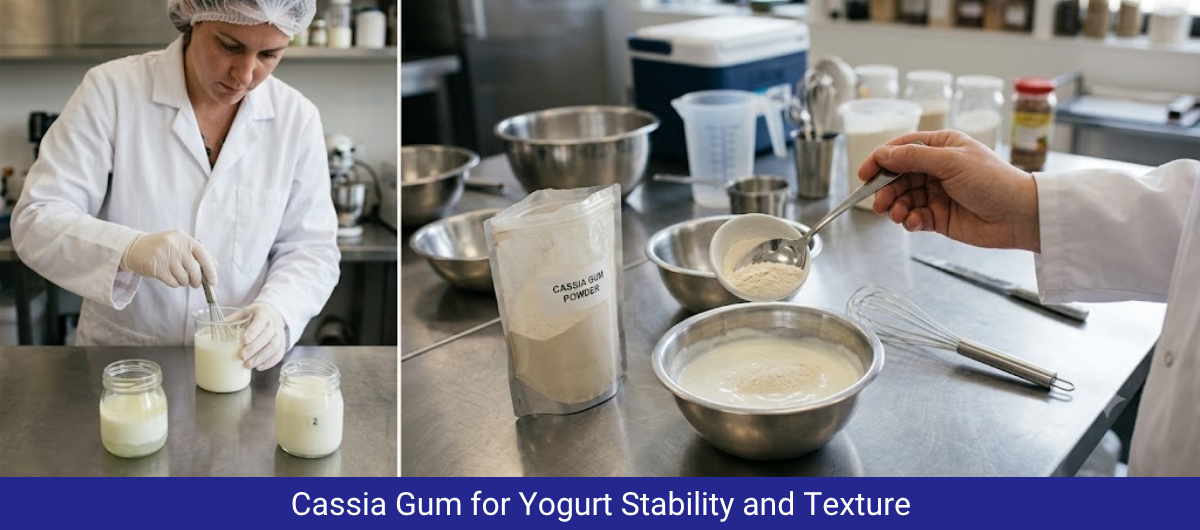
Yogurt is one of the most syneresis prone dairy products because its gel is formed purely by acidification, which produces a relatively fragile casein network. Stirred yogurts, drinking yogurts and fruit preparations are especially vulnerable because mechanical handling disrupts the gel further.
Adding cassia gum powder strengthens the water holding capacity of the yogurt system. The thickened serum phase resists separation, so the finished product stays homogeneous from production through to the point of consumption. Beyond syneresis control, cassia gum improves body and creaminess, giving low fat and reduced fat yogurts a richer mouthfeel that would otherwise be hard to achieve. In desserts, mousses and whey protein based products, the same water binding and texturising behaviour delivers a stable, indulgent result.
Benefits Beyond Syneresis Control
While moisture control is the headline benefit, cassia gum brings several other advantages to dairy formulation.
- Improved mouthfeel. The gum adds a smooth, full body that enhances the eating experience, particularly in reduced fat formats.
- Texture and tenderness. In cheese it supports a tender, cohesive structure rather than a crumbly or rubbery one.
- Freeze thaw stability. The strong water binding helps frozen dairy desserts resist ice crystal growth and the separation that follows thawing.
- Formulation efficiency. Because galactomannans thicken efficiently, low inclusion rates deliver meaningful stabilisation, which keeps cost in check.
- Natural origin. As a plant derived seed gum, cassia gum suits clean label and natural positioning in dairy products.
Our Other Product
Guar Gum PowderPractical Tips for Dairy Formulators
To get reliable syneresis control from cassia gum powder, a few formulation points are worth attention.
- Ensure full hydration. Cassia gum hydrates best with adequate water and heat. Disperse it well to prevent lumps and allow the chains to develop viscosity before the gel sets.
- Tune synergy. Combining cassia gum with xanthan can build a firmer gel and stronger water binding at a lower total dose. Adjust the ratio to match the target texture.
- Match the dose to the system. Acidified products like yogurt and heat set products like processed cheese behave differently. Trial inclusion rates in small batches to find the optimum for each.
- Control process stress. Cassia gum reduces syneresis, but gentle handling, controlled acidification and stable storage temperatures all work alongside it for the best result.
Cassia Gum as a Locust Bean Gum Alternative in Dairy
Locust bean gum has long been a workhorse galactomannan in dairy, prized for its synergy with carrageenan and xanthan and its smooth texturising effect. It is also relatively expensive and subject to supply variability, since it depends on the carob harvest. Cassia gum, another galactomannan with a similar mannose to galactose structure, offers dairy formulators a functional alternative for many of these roles.
In practice this means a processor can use cassia gum to achieve comparable water binding, syneresis control and textural improvement in cheese, yogurt and dessert systems, often at a more favourable and stable cost. Because the two gums share the galactomannan family, cassia gum slots into formulations designed around locust bean gum with manageable adjustment, and it participates in similar synergies with xanthan and carrageenan. For dairy manufacturers managing input cost and supply risk, having a reliable galactomannan alternative is a real advantage, and cassia gum fills that need while delivering the moisture control that prevents syneresis.
Read Our Article
How Fast Hydration Guar Gum Supports Mining and Geological Drilling?Freeze Thaw Stability in Frozen Dairy Desserts
Syneresis has a close cousin in frozen dairy: the damage caused by freeze thaw cycles. Ice creams, frozen yogurts and frozen desserts pass through temperature fluctuations during storage and distribution, and each cycle gives water the chance to migrate and form larger ice crystals. The result is a coarse, icy texture and, on thawing, separation and weeping that mirror the syneresis seen in chilled products.
The strong water binding capacity of cassia gum helps here as well. By immobilising water in the matrix, the gum slows the growth of ice crystals and limits the migration that causes coarsening. It also reduces the separation that appears when a frozen dessert partially thaws and refreezes. The same property that keeps yogurt from weeping in the cup keeps a frozen dessert smooth through the cold chain. For formulators, this makes cassia gum a dual purpose stabiliser, controlling syneresis in chilled products and ice crystal formation in frozen ones.
Call Now for Quick Support
 Call Now
The Role of Cassia Gum in Reduced Fat Dairy
As consumer demand pushes toward lower fat dairy, formulators face a texture problem. Fat contributes much of the richness, body and creamy mouthfeel of full fat products. Removing it tends to leave a thin, watery result that disappoints. Stabilisers and texturisers are used to rebuild that lost body, and cassia gum is well suited to the task.
By thickening the water phase and binding moisture, cassia gum restores body and a smooth, creamy mouthfeel to reduced fat yogurts, cheeses and desserts. It mimics some of the textural contribution of fat, helping a lower fat product feel closer to its full fat counterpart. At the same time it continues to control syneresis, which is often more pronounced in reduced fat systems because there is less fat to occupy and stabilise the structure. This combination of texturising and stabilising in a single natural ingredient is one of the reasons cassia gum is valued across modern dairy formulation.
Sourcing Quality Cassia Gum Powder for Dairy
Consistent performance in dairy depends on consistent raw material. Purity, galactomannan content, viscosity and microbiological quality all affect how cassia gum behaves in a real product, and food grade material must meet strict standards for human consumption.
Avlast Hydrocolloids manufactures and supplies food grade cassia gum powder engineered for stability and texture in cheese, yogurt, desserts and other dairy applications. For processors looking to eliminate whey separation, improve mouthfeel and extend shelf life, cassia gum powder offers a natural and effective answer. To discuss your formulation or request a sample, contact the Avlast Hydrocolloids team.
Frequently Asked Questions
What is syneresis in dairy products?
Syneresis is the expulsion of liquid, usually whey, from a set gel. In cheese and yogurt the casein protein network traps water, and as that network contracts during storage or handling it squeezes out some of the water, which appears as free liquid on the surface.
How does cassia gum powder control syneresis?
Cassia gum is a galactomannan with high water binding capacity. When hydrated it thickens the water phase and immobilises moisture between the protein strands, so even as the network contracts the water is held by the gum rather than expelled, keeping the product stable and uniform.
Can cassia gum replace locust bean gum in dairy?
Cassia gum is a galactomannan with a similar structure to locust bean gum and can serve as a functional alternative in many dairy applications, offering comparable water binding and texturising, often at a more favourable and stable cost, and with similar synergy with xanthan and carrageenan.
Is cassia gum suitable for yogurt?
Yes. Yogurt is highly prone to syneresis because its gel forms purely by acidification. Cassia gum strengthens water holding capacity, prevents watery separation and improves body and creaminess, which is especially useful in low and reduced fat yogurts.
Does cassia gum help in frozen dairy desserts?
Its strong water binding slows ice crystal growth and limits the migration that coarsens texture during freeze thaw cycles, and it reduces separation on thawing, making it useful as a stabiliser in ice cream and frozen desserts as well as chilled dairy.
Is cassia gum a natural ingredient?
Cassia gum is a plant derived seed gum obtained from Cassia tora, which suits clean label and natural positioning in dairy when food grade material meeting the appropriate standards is used.
About Avlast Hydrocolloids
Avlast Hydrocolloids is a reputed manufacturer and global distributor of cassia gum powder, guar gum powder and their derivatives, based in Ahmedabad, Gujarat, India. The company processes natural seed gums from raw seed through to finished powder, supplying food grade and industrial grade material to customers across the food, pet food, animal feed, cosmetics, pharmaceutical and industrial sectors worldwide.
Its product range covers cassia gum powder, cassia tora splits, cassia tora meal and cassia tora seed, alongside guar gum powder, fast hydration guar gum powder, guar refined splits and guar meal. With a focus on consistent quality, controlled specifications and dependable export supply, Avlast Hydrocolloids serves manufacturers who need natural thickening, gelling, binding and stabilising solutions they can rely on batch after batch. To discuss specifications or request a sample, contact the Avlast Hydrocolloids team.
Dhaval Patel is the CEO of Avlast Hydrocolloids, a manufacturer, supplier and exporter of hydrocolloid products based in Ahmedabad, India. Avlast Hydrocolloids specializes in Guar Gum and Cassia Gum products, serving customers across food, pet food, animal feed, pharmaceutical, personal care and various industrial applications.
With a strong focus on product quality, consistency and application-specific requirements, Avlast Hydrocolloids offers products including Guar Gum Powder, Fast Hydration Guar Gum Powder, Guar Refined Splits, Cassia Gum Powder, Cassia Tora Splits and other hydrocolloid ingredients. The company serves both domestic and international markets, with a focus on meeting industry-specific quality and performance requirements.
Through its industry-focused content, Avlast Hydrocolloids shares practical and informative insights about guar gum, cassia gum, hydrocolloids, their properties, applications, specifications and use across different industries. The content is intended to provide accurate and useful information for manufacturers, formulators, buyers, importers and other professionals looking to understand hydrocolloid ingredients and their applications.
Share At:




Listen to the Audio Version
0:00 /
0:00